





Peptides
Adipotide: Mechanism of Action and Preclinical Research Overview
14
Jul
Jul
What Is Adipotide?
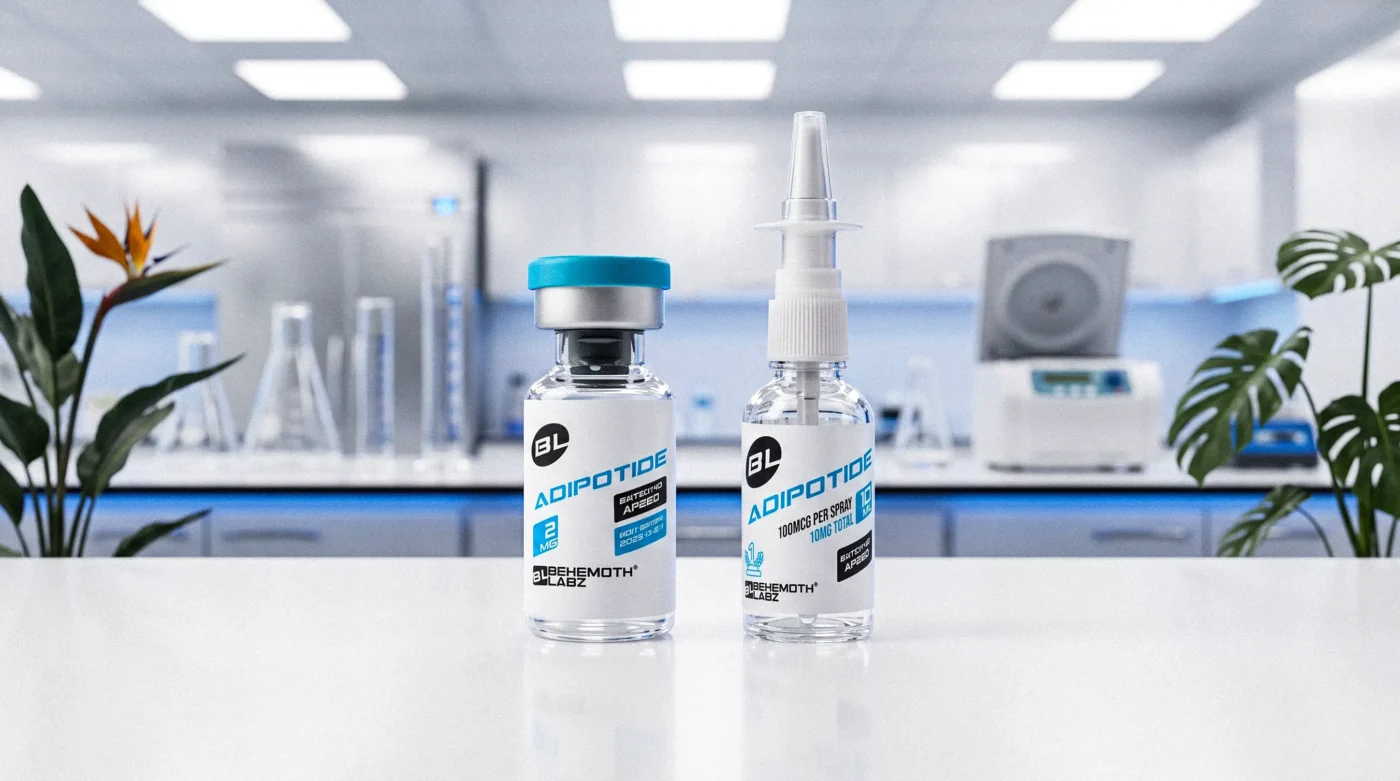
Adipotide, also known as FTPP (Fat-Targeted Proapoptotic Peptide), is a synthetic peptidomimetic compound with the sequence CKGGRAKDC-GG-D(KLAKLAK)₂. It was developed at the M.D. Anderson Cancer Center by the laboratories of Renata Pasqualini and Wadih Arap. It is a bipartite molecule — composed of a white-adipose-tissue-targeting domain fused via a glycine linker to a proapoptotic domain. Development was discontinued following renal toxicity findings in primate studies. It is not FDA-approved for any use and is supplied strictly for laboratory research. Researchers looking to buy Adipotide for laboratory investigation can source it as a research-grade compound at BehemothLabz. All products are independently third-party tested, with COA available per batch. Sold strictly for laboratory research only. Renal Toxicity Notice: Published primate model data (Barnhart et al. 2011) documented dose-dependent renal toxicity as a significant adverse signal associated with Adipotide at effective dose levels. This finding was the primary reason development was discontinued. Researchers must incorporate monitoring of renal parameters into any experimental design involving Adipotide. Disclaimer: Adipotide (FTPP) is a research compound not approved by the U.S. FDA for any use. Strictly for laboratory research only.Adipotide Mechanism of Action
Adipotide operates through a two-domain targeting-apoptosis mechanism that is mechanistically distinct from all other research peptides in this class: Domain 1 — Homing sequence (CKGGRAKDC): Kolonin et al. (2004, Nature Medicine) used phage-display screening to identify CKGGRAKDC as a peptide sequence that homes selectively to prohibitin — a protein enriched on the luminal endothelium of blood vessels supplying white adipose tissue. Prohibitin expression on white adipose vasculature endothelium is upregulated relative to other vascular beds, providing the targeting specificity. GRP78 has also been proposed as a co-receptor in metabolically stressed adipose models. Domain 2 — Proapoptotic sequence (D(KLAKLAK)₂): The proapoptotic domain is an amphipathic peptide sequence that, upon cellular internalisation, disrupts mitochondrial membrane potential. This triggers cytochrome c release and caspase cascade activation — initiating the intrinsic apoptotic pathway in targeted endothelial cells. Downstream adipocyte apoptosis: The resulting vascular regression in white adipose depots reduces nutrient and oxygen delivery to the adjacent adipocyte population, promoting secondary adipocyte apoptosis through ischemic mechanisms. This two-stage mechanism — vascular targeting then adipocyte ischemia — is the defining pharmacological characteristic of Adipotide.Preclinical Research Findings
Published IACUC-compliant preclinical investigational data document the following findings for Adipotide:- Obese mouse model: Kolonin et al. (2004) documented reversal of obesity parameters in obese mice following Adipotide administration, with white adipose tissue mass reduction and metabolic parameter improvements in that IACUC-compliant study
- Primate model: Barnhart et al. (2011, Science Translational Medicine) documented approximately 11% body weight reduction in obese rhesus monkeys over 28 days in a 10-animal IACUC-compliant study — accompanied by dose-dependent renal toxicity findings including reversible kidney histopathology
- Metabolic parameter changes: reductions in leptin, improvements in insulin sensitivity markers, and triglyceride changes documented in animal model studies following adipose tissue regression
- Visceral and peripheral fat depot targeting: Barnhart et al. (2011) documented that targeting was not restricted to subcutaneous fat — the same white adipose vasculature supplies both visceral and peripheral depots
Adverse Signals Documented in Investigational Data
- Renal toxicity — dose-dependent reversible kidney histopathology documented in primate model (Barnhart et al. 2011) — the primary adverse signal leading to development discontinuation
- No liver toxicity findings documented at research concentrations in published rodent model data
- Appetite reduction documented in rodent models — not attributed to conditioned taste aversion in published data
Risks and Limitations of Adipotide (FTPP) Research
This section is mandatory reading before working with this compound in any laboratory setting. CRITICAL — Renal Toxicity Dose-dependent renal toxicity was documented in primate model studies (Barnhart et al. 2011) at effective dose ranges. This finding led to discontinuation of clinical development. Any experimental design involving Adipotide must include monitoring of renal parameters as a mandatory endpoint. Handling Precautions Adipotide is a proapoptotic peptidomimetic. Handle with trained laboratory personnel only. Use full PPE. Avoid all skin contact and inhalation. Handle as a high-risk compound throughout the experimental workflow. Storage Store lyophilised Adipotide at −20°C in a dry, dark environment. Protect from light, heat, and moisture. Verify COA per batch. Toxicity and Data Limitations The primary published primate study (Barnhart et al. 2011) involved 10 animals over 28 days. No long-term toxicological programme has been published. The scope of available safety data is narrow. Selectivity Limitations Prohibitin is expressed in adipose vasculature preferentially, but not exclusively. Off-target binding in other tissues cannot be excluded based on current published data. Researchers must design experiments with appropriate monitoring for off-target vascular effects.Conclusion
Adipotide's mechanism in preclinical models operates through a bipartite targeting-apoptosis strategy: prohibitin-directed homing to white adipose vasculature (CKGGRAKDC domain) followed by mitochondrial membrane disruption and intrinsic apoptotic cascade activation (D(KLAKLAK)₂ domain). Published preclinical data document adipose tissue regression and metabolic parameter changes in both rodent and primate models. The most significant finding from published preclinical data is dose-dependent renal toxicity in the Barnhart et al. 2011 primate study — the primary reason clinical development was discontinued. Any research programme involving Adipotide must incorporate renal monitoring and operate under IACUC-compliant protocols.FAQs
What is Adipotide's mechanism of action in preclinical models?
Adipotide operates via a two-domain mechanism: the CKGGRAKDC homing sequence targets prohibitin on white adipose vasculature endothelium; the D(KLAKLAK)₂ proapoptotic domain disrupts mitochondrial membrane potential upon internalisation, triggering intrinsic apoptosis. Secondary adipocyte apoptosis via ischemia follows vascular regression.What primate model data have been published for Adipotide?
Barnhart et al. (2011, Science Translational Medicine) documented approximately 11% body weight reduction in 10 obese rhesus monkeys over 28 days. The study also documented dose-dependent reversible renal toxicity — the primary adverse signal finding from published primate data.Why was Adipotide's development discontinued?
Clinical development was discontinued following dose-dependent renal toxicity findings in the Barnhart et al. 2011 primate study. Renal histopathology was documented at effective dose levels, representing an unacceptable safety signal for clinical progression.Is Adipotide FDA-approved?
No. Adipotide is not approved for any use. Clinical development was discontinued. It is available strictly for laboratory research.References
- Kolonin MG, Saha PK, Chan L, Pasqualini R, Arap W. Reversal of obesity by targeted ablation of adipose tissue. Nature Medicine. 2004;10(6):625–632. https://pubmed.ncbi.nlm.nih.gov/15133506/
- Barnhart KF, Christianson DR, Hanley PW, et al. A peptidomimetic targeting white fat causes weight loss and improved insulin resistance in obese monkeys. Science Translational Medicine. 2011;3(108):108ra112. https://pubmed.ncbi.nlm.nih.gov/22072637/
