


SARMs
RAD 150 (TLB 150) Review: Research Benefits, Uses, and Potential Side Effects
Jan
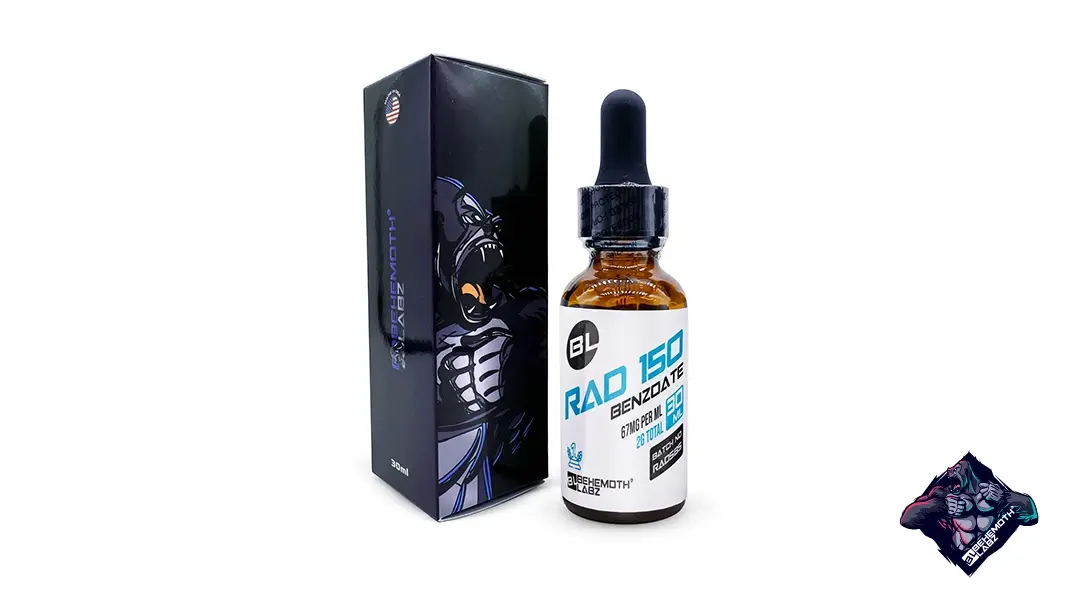
RAD 150, also called TLB 150 benzoate, is a synthetic selective androgen receptor modulator (SARM) investigated in preclinical models. It is a benzoate ester of RAD 140, studied for androgen receptor interaction and pharmacokinetic stability. It is not approved by the FDA for human use, and dedicated RAD 150 data remain limited.
RAD 150 (TLB 150) is a nonsteroidal, benzoate-ester SARM derived from RAD 140 (Testolone). Within laboratory research, it is examined as a tool for studying androgen receptor (AR) binding, tissue-selective anabolic signaling, and structure–activity relationships against non-esterified SARMs. The benzoate group is added to RAD 140 through esterification, a modification hypothesized to alter lipophilicity and metabolic stability and, in turn, to extend the compound's functional half-life relative to its parent, as discussed by suppliers characterizing the reagent for laboratory and analytical research.
It is important to state the limits of the evidence up front. Peer-reviewed literature specific to RAD 150 is sparse; most mechanistic understanding is extrapolated from RAD 140, the molecule RAD 150 is thought to release upon ester hydrolysis. RAD 140 itself has a documented preclinical record, including high-affinity androgen receptor binding and tissue-selective activity observed in animal models. This article summarizes what is known about RAD 150's molecular characteristics, its hypothesized mechanism, the research areas in which comparable SARMs have been investigated, and the handling and safety limitations that govern its use as a research reagent.
Disclaimer: RAD 150 (TLB 150) is a research compound not approved by the U.S. Food and Drug Administration (FDA) for human or veterinary use. It is not intended to diagnose, treat, cure, or prevent any disease. This product is strictly for laboratory research purposes only.
What Is RAD 150 (TLB 150)?
RAD 150 is a synthetic benzoate ester of RAD 140, classified as a nonsteroidal selective androgen receptor modulator. Chemically, it is RAD 140 conjugated with a benzoic acid group via esterification, a modification intended to change the molecule's stability profile in experimental settings.
The rationale reported by reagent characterizations is straightforward at the level of chemistry: adding a lipophilic benzoate ester is thought to slow metabolic clearance, so plasma-equivalent concentrations in a model system may remain steadier over time. Under this hypothesis, esterases progressively hydrolyze RAD 150 back to RAD 140, the active androgen receptor ligand. This positions RAD 150 as a prodrug-style analog of RAD 140 rather than a mechanistically distinct compound. That distinction matters for study design: researchers examining RAD 150 are, functionally, studying a slower-releasing source of RAD 140 activity, and findings are not consistent across all models given the limited dedicated data.
Common identifiers researchers encounter include RAD 150, TLB 150, TLB-150 benzoate, and "RAD 140 benzoate."
How Does RAD 150 Work? Mechanism of Action
RAD 150 is hypothesized to act as a source of RAD 140, which binds the androgen receptor with high affinity and selectivity in preclinical models. The intact ester is thought to be hydrolyzed to RAD 140, which then engages the AR in skeletal muscle and bone tissue. Effect data specific to RAD 150 remain limited.
Mechanistically, the sequence studied for the parent compound proceeds in ordered steps. RAD 140 docks at the ligand-binding domain of the androgen receptor — a binding pocket for which it shows strong affinity, reported at Ki ≈ 7 nM versus roughly 29 nM for testosterone and 10 nM for DHT in receptor-binding assays. Ligand binding is thought to trigger a conformational shift in the receptor, dissociation of chaperone proteins, receptor dimerization, and translocation to the nucleus, where the complex modulates transcription of androgen-responsive genes. In muscle and bone cell models this cascade is associated with anabolic gene expression, while activation in prostate tissue was comparatively low — the tissue-selectivity that distinguishes SARMs from steroidal androgens in preclinical characterization.
A separate line of investigation observed a distinct behavior in androgen-receptor/estrogen-receptor–positive (AR/ER+) breast cancer models, where RAD 140 acted through AR-mediated repression of ESR1 and suppressed xenograft growth in laboratory studies. These findings are mechanistic and preclinical; they are not evidence of any clinical effect, and no equivalent dedicated dataset exists for RAD 150.
RAD 150 vs RAD 140: What Is the Difference?
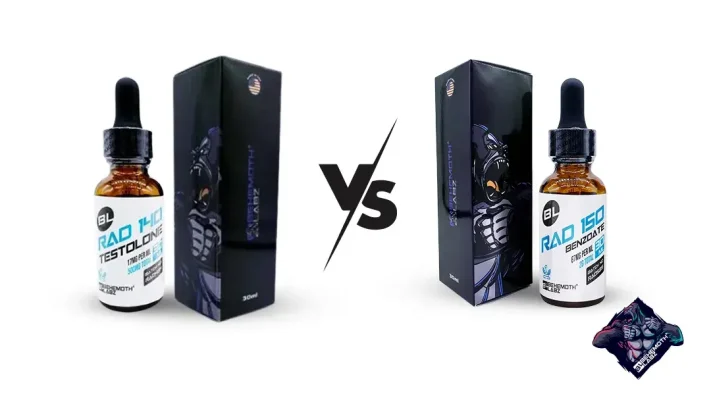
The core difference is structural: RAD 150 is the benzoate ester of RAD 140, so RAD 150 is designed for greater lipophilic stability while RAD 140 is the underlying active androgen receptor ligand. Their receptor mechanism is understood to be the same because RAD 150 is thought to hydrolyze to RAD 140.
Reported estimates place RAD 140's half-life at roughly 20–60 hours in the available literature, and vendors characterizing RAD 150 describe an extended functional duration on the assumption of slower ester release; these half-life figures for RAD 150 are estimates, not values established in peer-reviewed pharmacokinetic studies. The table below summarizes the attributes researchers most often compare.
| Attribute | RAD 140 (Testolone) | RAD 150 (TLB 150) |
|---|---|---|
| Chemical class | Nonsteroidal SARM | Benzoate ester of RAD 140 |
| Active AR ligand | RAD 140 itself | RAD 140 (released via hydrolysis) |
| Modification | None | Benzoic acid ester group |
| Reported stability | Baseline | Hypothesized higher lipophilic stability |
| Half-life status | Estimated ~20–60 h in literature | Estimated longer; not established in peer-reviewed PK studies |
| Primary literature | Documented preclinical record | Sparse; inferred from RAD 140 |
| Mechanism | High-affinity AR binding | Same, as a slower-releasing source |
What Are the Research Applications of RAD 150?
RAD 150 is studied primarily as a tool for androgen receptor pharmacology and structure–activity comparison against non-esterified SARMs. Because dedicated data are limited, most application areas are extrapolated from RAD 140 and framed strictly as preclinical research questions, not outcomes.
The table below maps the research areas of interest to the broader field each sits within.
| Area of Research | Research Note |
|---|---|
| Androgen receptor modulation | Examined for tissue-selective AR binding and transcriptional signaling; RAD 140 shows high AR affinity in receptor assays. |
| Skeletal muscle signaling | Within musculoskeletal pharmacology, RAD 140 was associated with increased lean mass in preclinical models observed in animal studies. |
| Bone mineral density | Studied in the context of skeletal adaptation research; changes reported for RAD 140 in rodent models in preclinical work. |
| Oncology model systems | Within hormone-receptor biology, RAD 140 was investigated in AR/ER+ breast cancer models via ESR1 repression in laboratory studies. |
| Ester pharmacokinetics | Within prodrug/SAR research, the benzoate modification is studied for its effect on stability and release kinetics. |
None of these areas should be read as evidence of efficacy for any condition. They describe questions researchers investigate in controlled model systems.
Physical, Structural, and Handling Properties
RAD 150 is supplied as a research reagent in solution or capsule form for laboratory use, characterized as a benzoate ester of the nonsteroidal SARM RAD 140. It is lipophilic, which underlies its hypothesized stability profile, and is typically dissolved in a suitable solvent carrier for in-vitro or in-vivo model work.
Handling parameters — concentration, solvent, and administration route in a model system — are determined entirely by study design, the model organism or assay, and institutional protocol. There is no established human dosing, and specific "cycle" or milligram-per-day figures circulated online describe non-sanctioned human use rather than validated research parameters; they should not be treated as guidance. Purity and identity should be confirmed by Certificate of Analysis before any experimental use.
What Are the Risks and Limitations of RAD 150 Research?
This section is mandatory reading before working with RAD 150 in any laboratory setting.
- Handling Precautions: RAD 150 should be handled by trained laboratory personnel only, in a controlled research environment. Use appropriate PPE at all times. Avoid direct skin contact or inhalation of any reconstituted solution.
- Exposure Risks: RAD 150 is a benzoate-ester SARM thought to release RAD 140, a high-affinity androgen receptor ligand, in preclinical models. No human safety data exist for this compound, and it is not characterized for any exposure in humans.
- Class-Level Hepatotoxicity Signal: SARMs as a class have been associated with drug-induced liver injury in published case analyses, including cholestatic and hepatocellular patterns reported in adverse-event reviews and catalogued by NIH LiverTox. This underscores why the class is restricted to research contexts.
- Regulatory and Anti-Doping Status: SARMs are unapproved drugs and are prohibited in sport by anti-doping authorities; non-research use is subject to legal and regulatory restriction, and product quality outside the research-supply chain is frequently unverified per systematic review of athlete SARM use.
- Storage: Store RAD 150 in a cool, dry, dark environment; protect from light, heat, and moisture, and follow the supplier's stability guidance for the specific formulation.
- Toxicity and Data Limitations: No chronic toxicity data exist for RAD 150 specifically. Dedicated peer-reviewed literature is sparse, and available evidence for physical-performance endpoints across the SARM class remains limited and inconsistent in randomized-trial review.
Frequently Asked Questions
Is RAD 150 a steroid? No. RAD 150 is a nonsteroidal selective androgen receptor modulator (SARM) and a benzoate ester of RAD 140. It is not an anabolic-androgenic steroid and is studied through a receptor-selective mechanism, not the broad androgenic activation associated with steroids.
What is the parent compound of RAD 150? RAD 150 is derived from RAD 140 (Testolone). A benzoic acid group is added via esterification, and RAD 150 is thought to hydrolyze back to RAD 140, the active androgen receptor ligand, in model systems.
How does RAD 150 differ from RAD 140 in half-life? RAD 150 is hypothesized to have a longer functional half-life than RAD 140 because the benzoate ester may slow metabolic clearance. These are estimates; no peer-reviewed pharmacokinetic study has established RAD 150's half-life, so findings are not consistent or confirmed.
Is there dedicated research on RAD 150? Peer-reviewed literature specific to RAD 150 is limited. Most mechanistic understanding is extrapolated from RAD 140, which has a documented preclinical record of high-affinity androgen receptor binding and tissue-selective activity in animal models.
What research areas involve RAD 150? In laboratory settings, RAD 150 and its parent RAD 140 have been examined in androgen receptor pharmacology, musculoskeletal signaling, bone-density models, and AR/ER+ oncology models. These are preclinical research questions only and do not indicate any approved application.
Conclusion
RAD 150 (TLB 150) is a benzoate-ester SARM studied as a slower-releasing source of RAD 140 for androgen receptor research. Its chemical modification is of interest for stability and structure–activity questions, but dedicated peer-reviewed data are sparse, and its mechanism is largely inferred from its parent compound. Reported half-life and stability advantages remain estimates rather than established pharmacokinetic findings. RAD 150 is not approved by the FDA for human or veterinary use, carries a class-level hepatotoxicity signal, and is prohibited in sport. It should be treated strictly as a laboratory research reagent, and conclusions about its activity should stay within that preclinical, data-limited frame.
References
- Miller CP, et al. Design, Synthesis, and Preclinical Characterization of the Selective Androgen Receptor Modulator (SARM) RAD140. ACS Medicinal Chemistry Letters. https://pubs.acs.org/doi/abs/10.1021/ml1002508
- Puskas B, et al. Preclinical assessment of the selective androgen receptor modulator RAD140 to increase muscle mass and bone mineral density. Physiological Reports (2025). https://physoc.onlinelibrary.wiley.com/doi/full/10.14814/phy2.70463
- Yu Z, et al. Selective Androgen Receptor Modulator RAD140 Inhibits the Growth of Androgen/Estrogen Receptor–Positive Breast Cancer Models with a Distinct Mechanism of Action. Clinical Cancer Research (2017). https://pubmed.ncbi.nlm.nih.gov/28974548/
- Selective androgen receptor modulator use and related adverse events including drug-induced liver injury: Analysis of suspected cases. European Journal of Clinical Pharmacology (2023). https://www.ncbi.nlm.nih.gov/pmc/articles/PMC10847181/
- Selective Androgen Receptor Modulators. NIH LiverTox. https://www.ncbi.nlm.nih.gov/books/NBK619971/
- Vasireddi N, et al. Athlete Selective Androgen Receptor Modulators Abuse: A Systematic Review. The American Journal of Sports Medicine (2025). https://pubmed.ncbi.nlm.nih.gov/39755947/
- Wen J, et al. Selective Androgen Receptor Modulators (SARMs) Effects on Physical Performance: A Systematic Review of Randomized Control Trials. Clinical Endocrinology (2025). https://onlinelibrary.wiley.com/doi/10.1111/cen.15135
What to Look for in a Supplier When Sourcing Research-Grade RAD 150
Check that every batch is independently third-party tested for purity and identity, and that a Certificate of Analysis (COA) is available for each lot. Prefer suppliers that sell strictly for preclinical and in-vitro research use. You can consider verified suppliers such as BehemothLabz, where compounds are sold strictly for preclinical and in-vitro research use.
Note: All products referenced are strictly for LABORATORY AND RESEARCH PURPOSES ONLY. They are not to be used for any human or veterinary purposes.
