




Peptides
Follistatin 344 (FST-344): Mechanism, Research & Preclinical Findings
Jun
Introduction
Follistatin 344 is the predominant circulating isoform of the follistatin glycoprotein family. It is encoded by the FST gene. Its development as a research compound is built on a unique 29-amino acid C-terminal extension. This gives FST-344 a longer half-life and broader systemic distribution than FST-288 and FST-317.
FST-344 is researched as a natural antagonist to myostatin. Myostatin is a negative regulator of skeletal muscle mass. By binding myostatin and related TGF-beta superfamily ligands, FST-344 suppresses SMAD2/3 signaling. In general, this pathway is linked to muscle atrophy, fibrosis, and growth inhibition in preclinical models.
Published scientific research has shown measurable changes in muscle fiber cross-sectional area, biochemical marker profiles, and downstream gene expression in preclinical systems. The implications of these findings are examined across multiple research domains. Sources across peer-reviewed literature also document FST-344 in activin receptor signaling, FSH suppression, cancer cell line studies, and fibrosis models. The impact of this compound on TGF-beta superfamily signaling makes it a compound of continued scientific interest.
Disclaimer: Follistatin 344 is a research compound not approved by the U.S. Food and Drug Administration (FDA) for human or veterinary use. It is not intended to diagnose, treat, cure, or prevent any disease. This product is strictly for laboratory research purposes only.
What Is Follistatin 344? Molecular Identity and Isoform Profile
Follistatin 344 is a secreted glycoprotein encoded by the FST gene. Its molecular weight ranges between 31 and 49 kDa, depending on the glycosylation state. The chemistry of this compound centres on three follistatin domain repeats (FSD1, FSD2, FSD3). These form the structural basis for high-affinity binding to myostatin, activin A, activin B, and other TGF-beta superfamily ligands.
How Does FST-344 Differ from Other Follistatin Isoforms?
Three primary isoforms exist: FST-288, FST-317, and FST-344. Other types within the follistatin family differ in C-terminal structure, heparin binding, tissue localization, and half-life. The table below summarizes the key differences across each isoform in the context of experimental research:
| Property | FST-288 | FST-317 | FST-344 |
| Amino Acid Length | 288 | 317 | 344 |
| C-Terminal Extension | Absent | Partial | Full 29 aa |
| Heparin Binding | High | Moderate | Low |
| Localization | Cell-surface | Tissue-bound | Systemic circulation |
| Half-Life | Short | Moderate | Longest |
| Research Use | Local tissue | Intermediate | Systemic models |
FST-288 anchors to the cell surface. FST-317 has partial heparin binding. FST-344 has the lowest heparin binding, the longest half-life, and is the preferred isoform for systemic experimental research. The kind of systemic bioavailability FST-344 achieves is not possible with the other isoform types.
Where Is Follistatin 344 Expressed in Biological Systems?
Key expression sites documented in scientific research:
- Skeletal muscle: Expression increases following muscle injury in preclinical studies.
- Ovary: High expression in granulosa cells. Examined for activin and FSH signaling regulation.
- Pituitary gland: Expressed in pituitary tissue. Studied for FSH secretion modulation.
- Liver: Hepatic expression observed. Considered a secondary circulating follistatin source.
- Adipose tissue: Detected in emerging experimental research. Functional role under investigation.
What Is the Mechanism of Follistatin 344 in Preclinical Models?
Follistatin 344 acts as a binding antagonist to TGF-beta superfamily ligands. The mechanism is straightforward: it neutralizes ligands before they can bind their receptors. It does not signal through receptors itself. This technique of upstream ligand sequestration is capable of suppressing multiple downstream signaling axes simultaneously.
How Does Follistatin 344 Inhibit Myostatin?
Myostatin (GDF-8) is a potent negative regulator of skeletal muscle mass. Elevated myostatin activity correlates with reduced muscle fiber size and increased atrophy in experimental models.
FST-344 binds myostatin with high picomolar affinity. This prevents myostatin from engaging the ActRIIB receptor complex. The result is suppression of SMAD2/3 phosphorylation and reduction of atrophy-related gene expression. Researchers have found that this mechanism can lead to measurable changes across multiple tissue types. FST-344 has also been examined for GDF-11 binding, discovered to share structural homology with myostatin, in ageing and tissue regeneration models.
In preclinical studies, myostatin inhibition by FST-344 produced measurable increases in muscle fiber cross-sectional area. These results were achieved via both recombinant protein and AAV-mediated gene delivery, with the latter shown to produce more sustained effects.
How Does Follistatin 344 Modulate Activin and TGF-Beta Signaling?
FST-344 binds activin A with high affinity and activin B with lower but documented affinity. This prevents activin receptor engagement and suppresses SMAD2/3 activation. The spread of pathway modulation includes broader TGF-beta superfamily signaling:
- Activin A blockade: Reduces fibrosis markers and SMAD2/3 phosphorylation. For example, activin A suppression in hepatic models reduced stellate cell activation markers in vitro.
- TGF-beta1 modulation: Follistatin does not directly bind TGF-beta1. It may indirectly reduce TGF-beta1-driven fibrotic effects through activin A suppression, since activin A mediates many of TGF-beta1's downstream fibrogenic actions in preclinical models.
- BMP modulation: Binds BMP-2, BMP-4, and BMP-7 at lower affinity than activin. Examined in bone formation and adipogenesis models.
Downstream gene expression changes include reduced atrogin-1 and MuRF-1, and increased MyoD and myogenin. These results are capable of being reproduced across multiple independent experimental systems.
What Role Does Follistatin 344 Play in Neurological and Reproductive Research?
In reproductive research, FST-344 binds activin in pituitary tissue, reducing FSH secretion. It has been studied in ovarian follicle maturation and implantation-related activin signaling in rodent models. These studies examine the relationship between FST-344 expression changes and observed hormonal shifts in preclinical systems.
In neurological research, FST-344 mRNA has been found in hippocampal tissue in preclinical models. Some studies have examined follistatin expression changes under stress conditions. Results remain preliminary and require further systematic investigation.
How Is Follistatin 344 Studied in Experimental Research?
What Preclinical Models Are Used?
Model selection is a hard decision in follistatin 344 experimental research. It determines whether experimental results can be meaningfully interpreted. Researchers select models based on physiological similarity, genetic background, and the research endpoint:
- Standard wild-type models: Establish baseline effect sizes and dose-response relationships.
- Dystrophic preclinical models: Carry a mutation causing progressive muscle degeneration. Used to examine FST-344 under existing muscle pathology conditions.
- Myostatin knockout models: Isolate myostatin-specific effects from broader TGF-beta changes.
- Higher-order preclinical models: Used in AAV-mediated gene delivery studies for closer physiological relevance.
All studies are designed with age-balanced and sex-balanced cohort structures. Formal power calculations determine sample size. Without this process, problems of underpowering can undermine the validity of experimental results.
What Administration Routes and Dosing Regimens Are Used?
AAV-mediated intramuscular gene delivery: FST-344 coding sequence is packaged into AAV vectors (serotypes 1, 6, and 8). The technique means a single administration produces sustained expression over months. This method was developed using higher-order preclinical models and achieved sustained follistatin expression across extended observation windows.
Recombinant protein administration: Used in shorter-duration studies. This technique requires multiple dosing to maintain circulating FST-344 levels. Protein purity is verified by SDS-PAGE and mass spectrometry before experimental use. Measurement error at this stage can confound downstream experimental results.
No standardized dosing protocol exists. Researchers determine dosing windows using pilot studies and prior pharmacokinetic data from published articles.
Plasma half-life consideration: FST-344 has an approximate plasma half-life of 3–4 hours in preclinical models. Biological activity at the tissue level persists for 24–48 hours due to proteoglycan interactions. Researchers designing dosing protocols should account for this distinction between plasma clearance and tissue retention when interpreting experimental results.
What Methods Are Used to Measure Experimental Results?
- Muscle and functional endpoints: DEXA and MRI for lean mass quantification. Grip strength dynamometry normalized to body weight. Ex vivo contractile force measurement.
- Biochemical markers: ELISA for circulating myostatin, follistatin, and activin. Western blot for SMAD2/3 phosphorylation. RT-PCR and qPCR for gene expression profiling. Each analytical machine used in these assays must be validated and calibrated before experimental use.
- Histology and imaging: H&E staining for fibre morphology. Immunofluorescence for fibre type and cross-sectional area. Masson trichrome for fibrosis quantification. MRI for longitudinal muscle volume tracking.
What Do Experimental Findings Show About Muscle Mass and Strength?
What Primary Outcome Measures Have Researchers Reported?
Experimental results across published studies have shown the following primary outcomes in FST-344 administered to preclinical models:
- Increased total muscle mass versus controls. Authors of landmark studies achieved these results using AAV-mediated gene delivery in higher-order preclinical models.
- Greater lean mass percentage by DEXA and MRI analysis
- Increased mean fiber cross-sectional area on immunofluorescence sections
- Increased normalized grip strength in adequately powered study cohorts
It is important to understand that AAV-mediated delivery produced larger and more sustained muscle mass increases than recombinant protein methods. Effect sizes were determined to range from moderate (Cohen's d 0.5 to 0.8) to large (greater than 0.8). Most findings reached statistical significance at p less than 0.05.
What Biochemical and Signaling Changes Are Observed?
- SMAD2/3 phosphorylation: SMAD2/3 phosphorylation was consistently reduced in muscle tissue lysates. The degree of suppression was found to correlate with follistatin expression levels in gene delivery models.
- Myostatin serum levels: Reduced circulating myostatin has been shown across multiple preclinical studies. Some authors report compensatory total myostatin upregulation alongside reduced free myostatin.
- Proteomic data: Reduced atrogin-1 and MuRF-1 protein expression. Increased myosin heavy chain isoforms were found in hypertrophic muscle samples.
What Do Transcriptomic and Proteomic Profiles Reveal?
- Downregulation of atrogin-1, MuRF-1, and myostatin in some models
- Upregulation of MyoD, myogenin, and satellite cell activation genes
- Reduced pro-fibrotic gene expression, including TGF-beta1 and CTGF, in dystrophic models
- Partial normalisation of extracellular matrix proteins in dystrophic preclinical models
What Does Follistatin 344 Research Show in Cancer and Fibrosis Models?
Follistatin 344 research in cancer and fibrosis models reveals a complex, context-dependent profile. All findings are from preclinical and in vitro experimental systems only. FST-344 is not a drug and has no approved treatment application. Its effectiveness in any clinical context has not been established.
In cancer research models, FST-344 demonstrates a dual role. Under certain circumstances, it shows tumour-suppressive observations:
- Tumour-suppressive observations: Reduced FST-344 expression documented in colorectal and ovarian cancer cell lines versus normal tissue controls. Researchers suggest this may relate to loss of activin-mediated growth regulation.
- Tumour-permissive observations: Elevated follistatin expression documented in prostate and breast cancer cell lines. Researchers have studied how this elevation relates to reduced activin-mediated growth suppression and may lead to changes in cancer cell behavior in these systems.
The spread of these dual observations across different cancer model types means FST-344 cannot be assigned a simple research profile in the oncology domain. Long-term oncogenic potential of sustained FST-344 expression has not been characterized. This represents a critical data gap.
In fibrosis models, FST-344 administration in dystrophic preclinical models showed reduced collagen deposition, decreased TGF-beta1 and CTGF expression, and reduced fibrotic area on Masson trichrome staining. Hepatic stellate cell activation reduction was observed in vitro but remains preliminary. It is important to note that this compound is not ingested in research settings. It is administered via controlled intramuscular or recombinant protein protocols only. All fibrosis findings are model-specific. No clinical data exists.
What Are the Data Analysis and Reproducibility Standards in Follistatin 344 Research?
Reproducibility requires pre-specified statistical methods, adequate sample sizes, and transparent reporting. In general, published studies apply ANOVA and t-tests for group comparisons, non-parametric tests when normality assumptions are not met, repeated measures analysis in longitudinal designs, and effect size reporting alongside p-values. Measurement error at any stage of the analysis process can have a significant impact on reported experimental results.
Preregistration on platforms such as the Open Science Framework is recommended but inconsistently adopted. Raw data and analysis code should be deposited in accessible sources. Many published articles do not meet current data-sharing standards. This means independent authors cannot fully verify or replicate reported findings. These are hard problems to address without field-wide adoption of open data practices.
Subgroup analyses by sex, age, and model type should be pre-specified. Independent replication is required before any single experimental finding can be considered built into the established scientific literature.
What Are the Risks and Limitations of Follistatin 344 Research?
This section is mandatory reading before working with Follistatin 344 in any laboratory setting.
Handling Precautions: Follistatin 344 should be handled by trained laboratory personnel only in a controlled research environment. Use appropriate PPE at all times. Avoid direct skin contact or inhalation of lyophilized powder or reconstituted solution. Dispose of all materials per institutional biosafety protocols.
Exposure Risks: Follistatin 344 is a recombinant glycoprotein research compound thought to modulate myostatin, activin, and TGF-beta superfamily signaling in preclinical experimental models. No human safety data exists. Under no circumstances should this compound be ingested or self-administered. Unintended exposure may produce biological effects that have not been characterized.
Storage: Store lyophilized Follistatin 344 at -20 degrees Celsius in a dry, dark environment. Reconstitute with sterile PBS. Store reconstituted solution at 4 degrees Celsius and use within 48 to 72 hours. Avoid repeated freeze-thaw cycles. Aliquot into single-use volumes before freezing.
Toxicity and Data Limitations: No chronic toxicity data exist for Follistatin 344. The effectiveness of any safety protocol depends on the quality of the data on which it is built. Long-term exposure effects and systemic toxicity thresholds have not been characterized. All findings are from short-duration preclinical models only.
Oncogenic Risk Uncertainty: FST-344 broadly suppresses activin signaling. Elevated follistatin expression has been documented in prostate and breast cancer cell line systems. The impact of this on long-term oncogenic risk is not fully determined. Long-term oncogenic potential via AAV delivery has not been characterized. Researchers conducting long-term studies must incorporate oncogenic monitoring, including histological assessment of non-target tissues. These are known problems in the broader gene delivery research literature.
What to Look for in a Supplier When Buying Research-Grade Follistatin 344?
Check that every batch is independently third-party tested for purity and identity. A Certificate of Analysis must be available for each lot. Product purity directly impacts the reliability of experimental results. Low-quality batches lead to measurement error and compromise research data.
- Third-party testing: Independent confirmation of purity and identity required.
- Certificate of Analysis: Must include HPLC purity trace and mass spectrometry identity confirmation with lot-specific traceability.
- Purity threshold: Minimum 95% purity by HPLC for research-grade recombinant protein.
- Endotoxin testing: Mandatory for compounds used in cell-based or in vivo experimental systems.
- Cold-chain compliance: Suppliers must confirm that storage and shipping conditions maintain compound integrity.
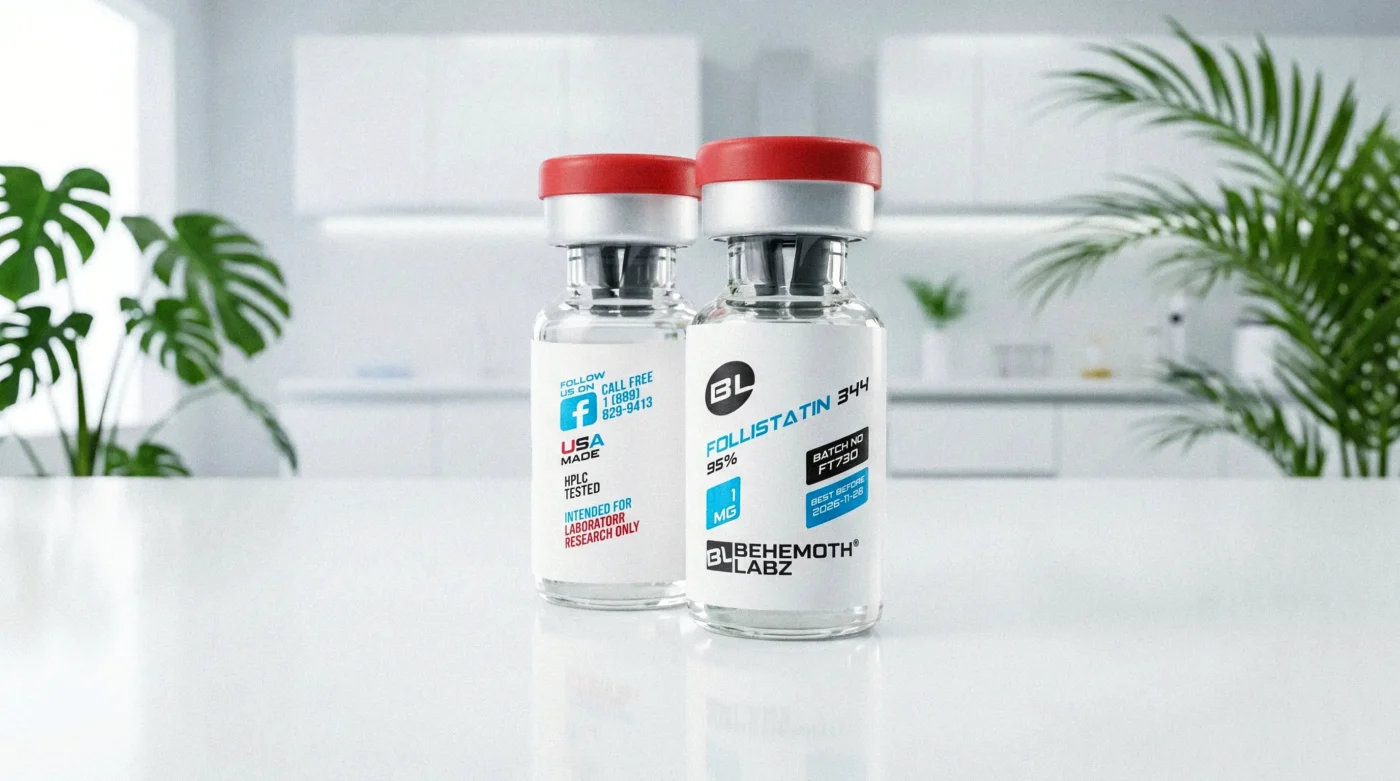
You can try trusted sites like BehemothLabz, where all compounds are sold strictly for preclinical and in vitro research use.
Note: All BehemothLabz products are strictly for LABORATORY AND RESEARCH PURPOSES ONLY. They are not to be used for any human or veterinary purposes.
Disclosure: Sponsored by BehemothLabz. This content is for informational purposes only and does not constitute an endorsement of any product for human use.
Conclusion
Follistatin 344 remains one of the most structurally capable isoforms studied in TGF-beta superfamily research. Experimental findings across preclinical models have shown measurable changes in muscle mass, SMAD2/3 signaling, and downstream gene expression. The implications of cancer and fibrosis model observations add complexity to its research profile, and independent replication of key findings remains an important next step. All evidence is strictly preclinical; no clinical data exists, and no approved treatment application has been established. Researchers working with this compound should confirm product purity, follow institutional biosafety protocols, and interpret experimental results within the boundaries of the model systems used.
Frequently Asked Questions
What is Follistatin 344, and how does it differ from other isoforms?
Follistatin 344 is a 344 amino acid glycoprotein isoform encoded by the FST gene. Its full 29 amino acid C-terminal extension reduces heparin binding and increases systemic bioavailability. This gives FST-344 the longest circulating half-life among follistatin isoforms. It is the predominant isoform used in systemic experimental research designs.
What does Follistatin 344 research show about myostatin inhibition?
FST-344 binds myostatin in a 2:1 stoichiometric ratio. This mechanism prevents ActRIIB receptor engagement and suppresses SMAD2/3 phosphorylation. Experimental results show reduced serum myostatin levels and increased muscle fiber cross-sectional area in FST-344-administered preclinical groups. All findings are strictly preclinical.
What preclinical models are used in Follistatin 344 experimental research?
Research uses wild-type murine models for baseline studies, dystrophic preclinical models for existing muscle pathology contexts, and higher-order preclinical models for AAV gene delivery studies. Cohorts are age-balanced and sex-balanced. Sample sizes are determined by formal power calculations to minimize error.
What are the risks of working with Follistatin 344 in a research setting?
Follistatin 344 must be handled by qualified professionals using full PPE in controlled laboratory environments. Under no circumstances should it be ingested or self-administered. No chronic toxicity data exists. Oncogenic risk uncertainty is a specific consideration given dual-role cancer model findings. All use must remain within approved preclinical and in vitro protocols.
What purity standards apply to research-grade Follistatin 344?
A minimum of 95% purity by HPLC is required. Identity must be confirmed by mass spectrometry. Endotoxin testing is mandatory for cell-based or in vivo experimental use. A lot-specific Certificate of Analysis covering all three confirmations must be reviewed before any batch enters experimental protocols.
Is Follistatin 344 approved for human use?
No. Follistatin 344 is not approved by the FDA for human or veterinary use. It is not intended to diagnose, treat, cure, or prevent any disease. All findings are from preclinical and in vitro experimental models. Access is restricted to qualified professionals in regulated laboratory settings.
References
- Lee SJ, McPherron AC. Regulation of myostatin activity and muscle growth. PNAS. 2001. PMID 11459935
- Nakamura T et al. Activin-binding protein from rat ovary is follistatin. Science. 1990. PMID 2367520
- Schneyer AL et al. Differential binding of activins A and B by follistatin. Endocrinology. 2008. PMID 18202141
- Schneyer AL, Sidis Y, Gulati A, Sun JL, Keutmann H, Krasney PA. Differential antagonism of activin, myostatin and growth and differentiation factor 11 by wild-type and mutant follistatin. Endocrinology. 2008;149(9): 4589-4595. PMID 18535106. https://pubmed.ncbi.nlm.nih.gov/18535106/
- Kota J et al. Follistatin gene delivery enhances muscle growth in nonhuman primates. Sci Transl Med. 2009. PMID 20368179
- Winbanks CE et al. Follistatin-mediated skeletal muscle hypertrophy regulated by Smad3 and mTOR. J Cell Biol. 2012. PMID 22508510
- Zhu J et al. Follistatin improves skeletal muscle healing after injury. Am J Pathol. 2011. PMID 21356370
- Sidis Y et al. Biological activity of follistatin isoforms. Endocrinology. 2006. PMID 16556760
- Phillips DJ, de Kretser DM. Follistatin: a multifunctional regulatory protein. Front Neuroendocrinol. 1998. PMID 9878256
- Amthor H et al. Follistatin complexes myostatin and antagonises myostatin-mediated inhibition of myogenesis. Dev Biol. 2004. PMID 15223338
- Leto G et al. Activin A and follistatin in malignant bone diseases. Front Biosci. 2011. PMID 21196166
- Matzuk MM et al. Multiple defects in mice deficient in follistatin. Nature. 1995. PMID 7651518
- Hedger MP, de Kretser DM. Activins and follistatin in inflammation and wound repair. Mol Cell Endocrinol. 2013. PMID 23246498
- Shimasaki S et al. Primary structure of the human follistatin precursor and its genomic organization. Proc Natl Acad Sci USA. 1988. PMID 3380788
- National Centre for Biotechnology Information. Follistatin 344. PubChem Compound Database. CID 166897982. National Library of Medicine.
