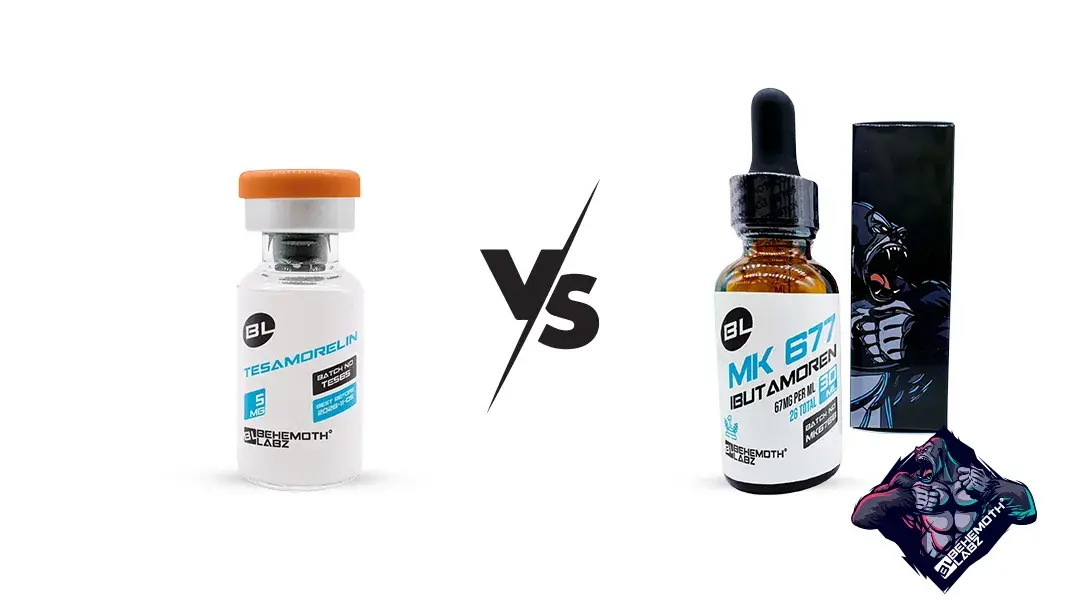


Tesamorelin VS MK677

Tesamorelin vs MK677

Tesamorelin is a GHRH analog peptide — injectable, short-acting (~26 min half-life), activating pituitary GHRH receptors to produce pulsatile GH release. MK-677 (Ibutamoren) is an oral ghrelin receptor agonist (GHSR-1a) — non-peptide, long-acting (~24 h half-life), triggering GH secretion through a distinct receptor pathway. Both  elevate GH and IGF-1 downstream. Research on both compounds is still evolving.

Two compounds. Both stimulate the GH axis in research models. Both elevate downstream IGF-1. But that is where the similarity ends.

The tesamorelin vs MK-677 comparison draws regular interest from research procurement teams precisely because the downstream output looks identical — elevated GH, elevated IGF-1 — while the mechanisms, delivery routes, data profiles, and regulatory histories could not be more different. Tesamorelin holds FDA approval. MK-677 — also known as Ibutamoren — does not. Tesamorelin is an injectable peptide with a 26-minute half-life. MK-677 is an oral non-peptide with a ~24-hour half-life. Tesamorelin works at GHRH receptors. Ibutamoren works on ghrelin receptors.

The Tesamorelin VS MK677 question is a receptor biology question first and a procurement question second. Getting the answer right requires understanding what each compound actually does at the molecular level — not just what it produces downstream.

Disclaimer: Tesamorelin and MK-677 (Ibutamoren) are research compounds. Tesamorelin is FDA-approved as EGRIFTA for HIV-associated lipodystrophy only — all other research applications are investigational. MK-677 is not approved by the FDA for any human or veterinary use. Neither compound is intended to diagnose, treat, cure, or prevent any disease. Both are strictly for laboratory and research purposes only.

Quick Verdict: Tesamorelin or MK-677 (Ibutamoren) for Research?

Tesamorelin is the correct compound when GHRH receptor-specific activation and a Phase 3 evidence base are required. MK-677 (Ibutamoren) is the correct compound when oral delivery, GHSR-1a pathway isolation, or sustained daily GH pulse research is the protocol requirement. Neither substitutes for the other — they study different receptor biology through entirely different molecular mechanisms.

What Is Tesamorelin?

Tesamorelin (also known as TH9507, EGRIFTA) is a synthetic GHRH analog consisting of the full 44-amino acid sequence of human growth hormone-releasing factor (GRF), with a trans-3-hexenoyl group attached to the N-terminal tyrosine residue. Molecular formula C₂₂₁H₃₆₆N₇₂O₆₇S, molecular weight 5,135.9 Da, CAS 218949-48-5, PubChem CID 16137828.

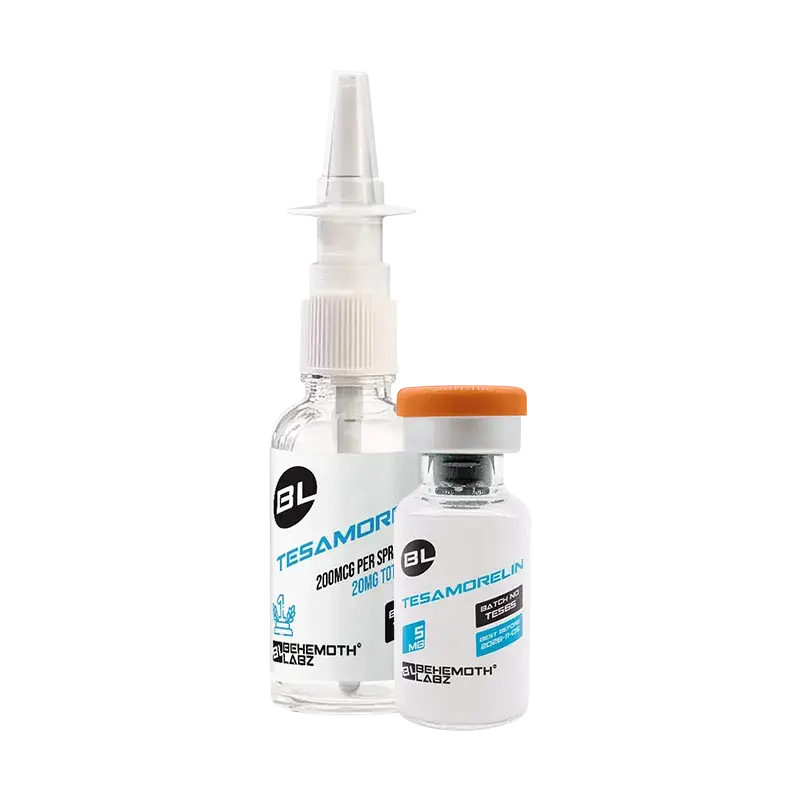
Tesamorelin Nasal Spray & Liquid

Buy Tesamorelin

It binds pituitary GHRH receptors (Gs-coupled GPCRs on somatotroph cells) with potency comparable to endogenous GRF, activating the cAMP/PKA cascade and stimulating pulsatile endogenous GH synthesis and release. The hexenoyl modification at the N-terminus increases metabolic stability relative to native GHRH — extending biological half-life to approximately 26 minutes — but subcutaneous injection remains the only viable delivery route. Tesamorelin does not directly administer GH; it amplifies the pituitary's natural GHRH-driven response.

Tesamorelin is FDA-approved under the brand name EGRIFTA for one indication: reduction of excess visceral abdominal fat in adults with HIV-associated lipodystrophy. Outside this indication, all research applications are investigational only.

What Is MK-677 (Ibutamoren)?

MK-677 — also known as Ibutamoren, MK-0677, and L-163,191 — is a non-peptide, orally active ghrelin receptor agonist (GHSR-1a agonist) with molecular formula C₂₇H₃₆N₄O₅S, molecular weight 528.66 g/mol, CAS 159634-47-6. It belongs to the spiroindoline compound class — a structural scaffold that enables oral bioavailability (~60–70%) that no peptide-based GH secretagogue can match.

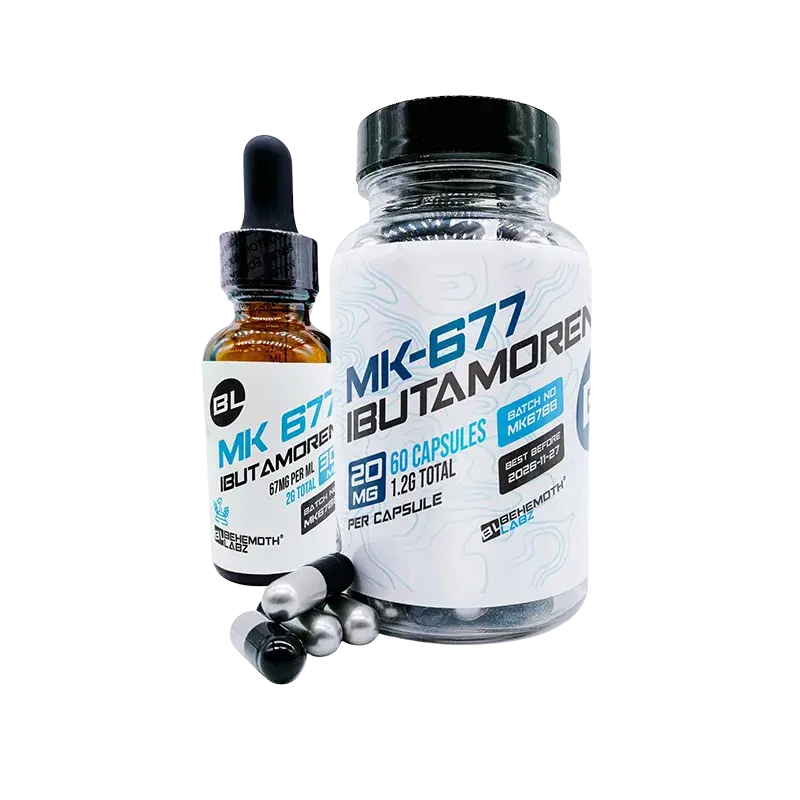
MK677 Liquid and Capsules

Buy MK-677

MK-677's mechanism is entirely distinct from Tesamorelin's. Rather than engaging GHRH receptors, it mimics ghrelin at GHSR-1a, triggering the Gq/PLC/IP3/calcium signaling cascade and stimulating GH-containing vesicle exocytosis from somatotroph cells. It also partially suppresses somatostatin tone and potentiates hypothalamic GHRH release — a dual amplification effect absent from Tesamorelin's mechanism. Its investigationally documented half-life of approximately 24 hours allows once-daily dosing intervals in in vivo research designs. MK-677 has not received FDA approval for any indication.

Tesamorelin vs MK-677: Side-by-Side Comparison Table

Property Tesamorelin MK-677 (Ibutamoren)
Also Known As TH9507, EGRIFTA Ibutamoren, MK-0677, L-163,191
Compound Class GHRH Analog Peptide Non-peptide GHSR-1a Agonist
Molecular Weight 5,135.9 Da 528.66 g/mol
CAS Number 218949-48-5 159634-47-6
PubChem CID 16137828 9918684
Primary Receptor GHRH-R (pituitary somatotroph) GHSR-1a (ghrelin receptor)
Mechanism cAMP/PKA → pulsatile GH synthesis Gq/PLC/IP3/Ca²⁺ → GH vesicle exocytosis
Delivery Route Subcutaneous injection only Oral (capsule or liquid)
Half-Life ~26 minutes ~24 hours (investigational data)
Oral Bioavailability None — peptide, injection only ~60–70%
FDA Approval Yes — HIV lipodystrophy (EGRIFTA) None
Published Human Data Phase 3 RCT evidence-based Early-phase investigational only
Somatostatin Suppression Not directly Partial — dual amplification
Available at Behemoth Labz Injectable Capsule + Liquid

When Should Researchers Choose Tesamorelin?

When GHRH receptor-specific activation is the research variable, Tesamorelin is the only appropriate choice. Its binding to GHRH-R with potency equivalent to endogenous GRF — confirmed in the FDA prescribing documentation — makes it the reference GHRH analog for pituitary somatotroph signaling research. MK-677 does not engage this receptor and cannot serve as a substitute in GHRH pathway studies.

When the most robust published database is required, the Falutz et al. (2010) Phase 3 RCT evidence base for Tesamorelin provides documented outcomes across 26–52 week controlled trials that MK-677's early-phase investigational literature cannot match. For research designs requiring cross-referencing with peer-reviewed outcomes data, Tesamorelin is the stronger anchor.

When injectable delivery and acute GH pulse dynamics are protocol requirements, Tesamorelin's 26-minute half-life is an advantage — enabling precisely timed, transient GH stimulation in study designs examining acute GHRH-receptor-driven GH release. Its short window also means its GH effect clears rapidly, reducing carry-over confounds between dosing intervals.

When Should Researchers Choose MK-677 (Ibutamoren)?

When oral delivery is required, MK-677 (Ibutamoren) is the only viable option in this comparison. Its oral bioavailability of ~60–70% and ~24-hour half-life make it the practical standard for multi-day in vivo protocols where injection-free administration is an experimental design requirement or a variable under study.

When GHSR-1a pathway pharmacology is the research focus, MK-677 is the correct reference compound. Its ghrelin receptor mechanism — Gq/PLC/IP3/calcium cascade — is mechanistically distinct from GHRH-R agonism and irreplaceable in research designs studying ghrelin pathway biology, somatostatin suppression, or dual-receptor GH stimulation.

When sustained IGF-1 elevation over a longer dosing window is the variable, MK-677's 24-hour half-life produces substantially more sustained receptor engagement than Tesamorelin's 26-minute window. The Chapman et al. (1996) investigational data reported a 97% increase in mean 24-hour GH concentrations and elevated IGF-1 within 2–4 weeks of oral MK-677 administration in the study cohort — investigational findings only, not an approved indication.

Can Tesamorelin and MK-677 Be Stacked in Research?

Because tesamorelin and MK-677 target different receptors — GHRH-R and GHSR-1a, respectively — their combination represents dual-pathway GH axis stimulation rather than single-site receptor competition. Preclinical models have examined GHRH analog and GHSR-1a agonist combinations to investigate additive GH pulse amplification, and the mechanistic rationale is sounder than combining two compounds targeting the same receptor site.

However, combining both substantially increases metabolic confounds — including additive IGF-1 elevation and mitogenic signaling risk — and requires explicit IACUC documentation addressing dual-pathway GH stimulation before any protocol proceeds. No peer-reviewed data exists specifically on the tesamorelin and MK-677 combination in any model system.

What Are the Risks and Limitations of Tesamorelin and MK-677 Research?

This section is mandatory reading before working with either compound in any laboratory setting.

Handling Precautions: Both compounds should be handled by trained laboratory personnel only, in a controlled research environment. Use appropriate PPE at all times — nitrile gloves, eye protection, and a lab coat. Tesamorelin requires lyophilized powder reconstitution; MK-677 is available as an oral capsule. Avoid direct skin contact or mucosal exposure during preparation.

Exposure Risks: Tesamorelin is a GHRH analog research peptide thought to activate pituitary GHRH receptors and stimulate pulsatile GH release in preclinical models. MK-677 (Ibutamoren) is a GHSR-1a agonist research compound thought to trigger GH vesicle exocytosis via Gq/PLC/IP3/calcium signaling. Both elevate circulating IGF-1 in experimental settings. Accidental exposure to either must be managed through institutional biosafety protocols immediately.

Storage: Store lyophilized Tesamorelin at −20°C in a sealed, desiccated, light-protected container; once reconstituted, store at 2–8°C and use within the protocol-specified window. Store MK-677 capsules at controlled room temperature (15–25°C), sealed, away from heat and humidity. Avoid repeated freeze-thaw cycles for Tesamorelin.

Toxicity and Data Limitations: Tesamorelin has Phase 3 RCT safety data in its approved HIV lipodystrophy indication — its profile outside this narrow population is less well characterized. MK-677 has no chronic toxicity data. All MK-677 findings beyond early-phase investigational studies derive from short-duration preclinical models only.

IGF-1 Elevation and Mitogenic Risk: Both compounds elevate IGF-1 as a downstream consequence of GH stimulation. IGF-1 is a known mitogenic signaling molecule. Sustained elevation in laboratory models carries an uncharacterized proliferative signaling risk. Protocols involving either compound in oncology or proliferation-sensitive model systems must address this explicitly in study ethics documentation. Carcinogenicity studies are absent for MK-677.

Where to Buy Tesamorelin and MK-677

Both compounds are available research-grade from Behemoth Labz, independently third-party tested by Colmaric Analyticals LLC (St. Petersburg, FL) with batch-specific Certificates of Analysis accessible at behemothlabz.com/certificate-of-analysis/ before purchase.

Buy Tesamorelin for GHRH receptor pathway research, and MK-677 (Ibutamoren) for GHSR-1a pathway and oral GH secretagogue research — both for laboratory and research purposes only, not for human or veterinary use outside approved indications.

Disclosure: This page contains affiliate links to Behemoth Labz products. Content is for informational purposes only. No product is endorsed for human use.

Behemoth Labz Verdict: Tesamorelin vs MK-677

Tesamorelin vs MK-677 — and ibutamoren vs tesamorelin and mk 677 vs tesamorelin across every keyword variation — is not a potency comparison. It is a receptor pathway selection. Tesamorelin studies the GHRH-R axis with a substantial published database and FDA approval in its indicated population. MK-677 (Ibutamoren) studies the GHSR-1a ghrelin axis with oral delivery, a longer active window, and early-phase investigational data. Research on both compounds is still evolving, and long-term data for MK-677 in particular remain absent.

Choose based on the receptor pathway your protocol targets, not the downstream output that both compounds produce. Neither is approved for research use beyond established parameters, and neither should be interpreted as suitable for human use outside of Tesamorelin's single FDA-approved indication.

FAQs — Tesamorelin vs MK-677

What is the difference between Tesamorelin and MK-677?

Tesamorelin is a GHRH analog — injectable, ~26-minute half-life, activates pituitary GHRH receptors. MK-677 (Ibutamoren) is a ghrelin receptor agonist (GHSR-1a) — oral, ~24-hour half-life, triggers GH release via Gq/PLC/IP3/calcium signaling. Both elevate GH and IGF-1 downstream but through completely different receptor mechanisms and delivery routes.

Is MK-677 the same as Tesamorelin? 

No. Tesamorelin mimics GHRH at pituitary GHRH-R receptors. Ibutamoren (MK-677) mimics ghrelin at GHSR-1a receptors. They cannot substitute for each other in receptor-specific mechanistic studies. The only shared outcome is downstream GH and IGF-1 elevation — the biology upstream is entirely distinct.

What is ibutamoren vs tesamorelin for GH axis research? 

For GHRH-R pathway studies, Tesamorelin is the appropriate compound. For GHSR-1a ghrelin pathway studies, MK-677 (Ibutamoren) is the appropriate compound. For protocols where oral delivery or sustained daily GH stimulation is the variable, MK-677 is the only viable option. For protocols requiring injectable precision dosing or cross-referencing with Phase 3 published data, Tesamorelin is the correct choice.

Can you stack Tesamorelin and MK-677 in research? 

Their dual-receptor targets — GHRH-R and GHSR-1a — make a tesamorelin and MK-677 stack mechanistically distinct from the same-receptor combinations. Preclinical dual-pathway GH stimulation models exist. However, combining both substantially increases IGF-1 elevation, metabolic confounds, and IACUC documentation requirements. No peer-reviewed data on the specific combination exists in any published model system.

Is Tesamorelin FDA-approved? 

Yes — Tesamorelin is FDA-approved as EGRIFTA specifically for the reduction of excess visceral abdominal fat in adults with HIV-associated lipodystrophy. This is its sole approved indication. All other research applications of Tesamorelin remain investigational and are not for human use outside this indication.

Where can I buy Tesamorelin and MK-677 for research? 

Research-grade Tesamorelin and MK-677 (Ibutamoren) are available at Behemoth Labz, independently tested by Colmaric Analyticals LLC with batch-specific COAs. Buy Tesamorelin and buy MK-677 Ibutamoren for laboratory and research purposes only.

References

  1. Falutz J, et al. (2010). Long-term safety and effects of tesamorelin, a growth hormone-releasing factor analogue, in HIV patients with abdominal fat accumulation. AIDS, 24(14), 2162–2171. PMID: 22050344. https://pubmed.ncbi.nlm.nih.gov/22050344/
  2. Chapman IM, et al. (1996). Stimulation of the Growth Hormone–Insulin-Like Growth Factor I Axis by Daily Oral Administration of a Selective Agonist of the Growth Hormone Secretagogue Receptor. Journal of Clinical Endocrinology & Metabolism, 81(12), 4249–4257. PMID: 8954023. https://pubmed.ncbi.nlm.nih.gov/8954023/ 

Leave a Reply