



Peptides
N-Acetyl Semax Amidate: Synthesis, Purity, and Research
May
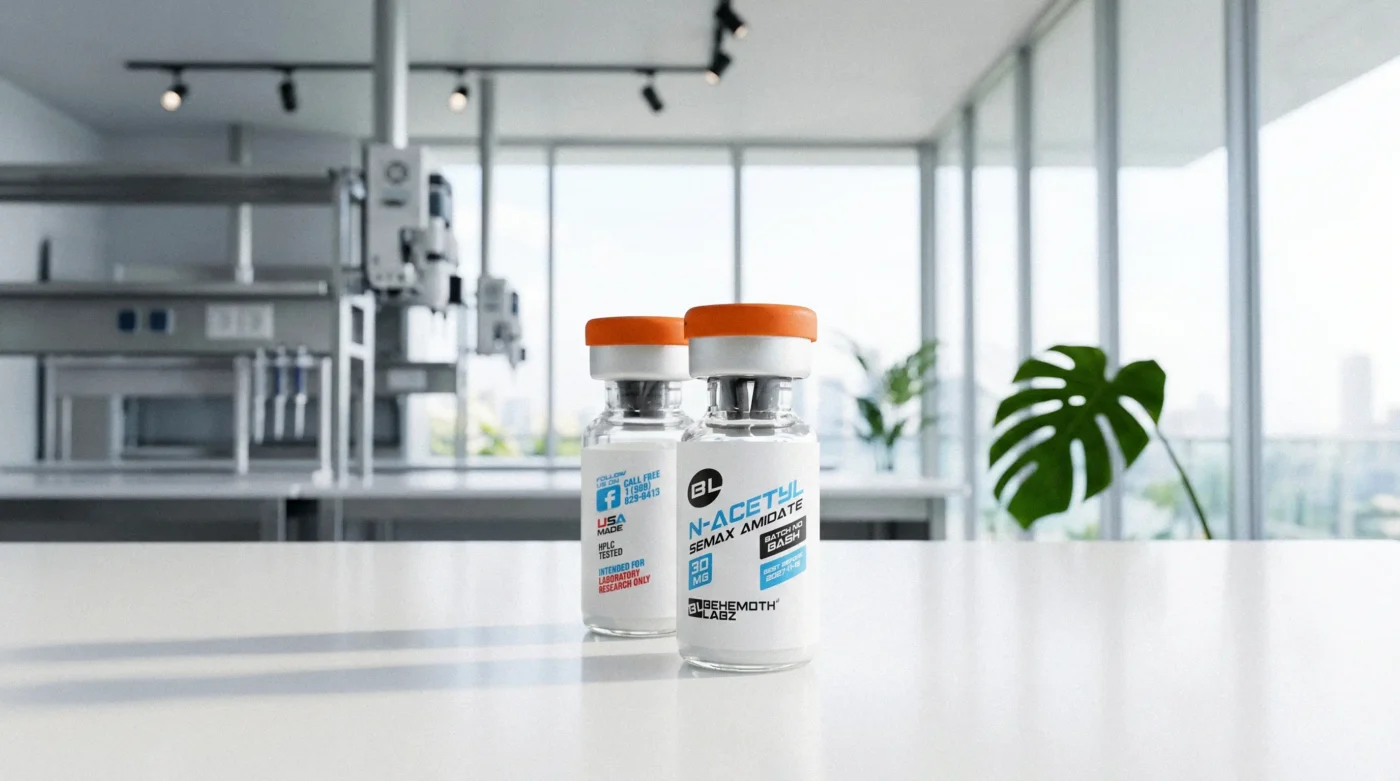
Standard Semax degrades within minutes of administration in experimental models, limiting its use in central nervous system research. N-Acetyl Semax Amidate addresses this through dual peptide modifications, N-terminal acetylation, and C-terminal amidation, which confer enhanced resistance to proteolytic degradation. This synthetic peptide is derived from the adrenocorticotropic hormone fragment ACTH(4-10) and is the most structurally stable analog in the Semax family. Research on this compound class spans BDNF expression, neuroprotective effects in ischemic stroke models, and cognitive enhancement in preclinical models.
In this blog, we cover the synthesis pathway, purity standards, mechanisms of action, and key preclinical findings for N-Acetyl Semax Amidate, within a laboratory research context.
Disclaimer: N-Acetyl Semax Amidate is a research compound not approved by the U.S. Food and Drug Administration (FDA) for human or veterinary use. It is not intended to diagnose, treat, cure, or prevent any disease. This product is strictly for laboratory research purposes only.
What Is N-Acetyl Semax Amidate?
N-Acetyl Semax Amidate is a synthetic peptide and the most structurally stable synthetic analog in the Semax lineage. It is derived from the adrenocorticotropic hormone fragment ACTH(4-10), carrying the sequence Ac-Met-Glu-His-Phe-Pro-Gly-Pro-NH2. The core Met-Glu-His-Phe sequence drives central nervous system receptor interaction, while the Pro-Gly-Pro extension provides baseline resistance to protease activity.
The compound applies N-terminal acetylation and C-terminal amidation simultaneously. These peptide modifications address proteolytic degradation, the primary reason unmodified Semax degrades within minutes of administration in experimental models. The enhanced resistance to enzymatic breakdown is the defining research characteristic of this compound. All findings discussed here are strictly preclinical. No human clinical data exists.
Molecular Profile
| Property | Value |
| Molecular Formula | C39H54N10O10S |
| Molecular Weight | 854.97 g/mol |
| CAS Number | 2920938-90-3 |
| PubChem CID | 172638603 |
| Sequence | Ac-Met-Glu-His-Phe-Pro-Gly-Pro-NH2 |
How Do the Peptide Modifications Work?
The two peptide modifications each block a specific proteolytic degradation pathway:
- N-terminal acetylation caps the free amine with an acetyl group (COCH3). This blocks aminopeptidase recognition and prevents sequential N-terminal cleavage.
- C-terminal amidation replaces the free carboxyl with a neutral amide (NH2). This blocks carboxypeptidase degradation and may influence receptor binding kinetics.
Together, both peptide modifications protect the termini simultaneously and confer enhanced resistance to protease activity. Preclinical inferences suggest this dual strategy may extend half-life by approximately 30 minutes relative to unmodified Semax. No formal comparative pharmacokinetic studies have confirmed this figure.
How Do Semax Variants Compare?
The Semax family includes multiple variants, each differing in terminal chemistry and stability:
| Variant | N-Terminus | C-Terminus | Stability |
| Semax | Free amine | Free carboxyl | Baseline |
| N-Acetyl Semax | Acetylated | Free carboxyl | Moderate |
| Semax Amidate | Free amine | Amidated | Moderate |
| N-Acetyl Semax Amidate | Acetylated | Amidated | Highest |
The practical research distinction: Semax Amidate protects only the C-terminus. N-Acetyl Semax Amidate protects both termini simultaneously. For research protocols requiring maximum compound availability over extended experimental timeframes, the dual-modification variant offers superior proteolytic stability in preclinical models.
How Is N-Acetyl Semax Amidate Synthesized?
Solid-phase peptide synthesis (SPPS) using the Fmoc strategy is the standard development pathway for this research-grade synthetic peptide. It enables sequential amino acid coupling, wash-based purification after each cycle, and C-terminal amidation through resin selection.
Key Synthesis Parameters
- Resin: Rink Amide resin — delivers C-terminal amidation upon TFA cleavage
- Resin loading: 0.4–0.7 mmol/g
- Coupling reagent: HATU or HBTU with DIPEA in DMF
- Reagent equivalents: 3–4 per coupling cycle
- Side-chain protection: Glu (OtBu), His (Trt); Met, Phe, Pro, Gly require none.
- Fmoc deprotection: Two sequential treatments with 20% piperidine in DMF
N-Acetylation On-Resin
After full chain assembly, the final Fmoc group is removed. Acetic anhydride (10–20% in DMF) with DIPEA acetylates the exposed N-terminal methionine amine. Completion is confirmed by the Kaiser test before cleavage proceeds.
Cleavage and Crude Workup
The assembled peptide is cleaved using a TFA-based cocktail, precipitated in cold diethyl ether, and washed before entering preparative HPLC purification.
How Is Product Purity Established?
Product purity is non-negotiable for reproducible results in experimental biology. Achieving research-grade purity requires two distinct steps. Neither substitutes for the other.
Preparative HPLC
A C18 reversed-phase column with 100 Å pore size is used. Mobile phase: water/acetonitrile, each with 0.1% TFA. A shallow preparative gradient of 0.3–1.0% acetonitrile per minute resolves the target from deletion sequences and impurities. Only fractions confirmed at ≥99% purity by analytical HPLC are pooled.
Mass Spectrometry and LC-MS Confirmation
Mass spectrometry via LC-MS verifies molecular weight at 854.97 g/mol and confirms that both terminal peptide modifications are intact. Mass spectrometry identity confirmation is mandatory; sequence and modification integrity cannot be assumed from HPLC alone. A valid Certificate of Analysis (COA) must include:
- Raw HPLC purity trace
- LC-MS identity spectrum
- Lot number for batch traceability
Researchers must confirm all three elements are present before using any batch in animal studies or in vitro protocols.
Lyophilization and Storage
Purified fractions are freeze-dried. Sublimation under vacuum removes >95% of water content, yielding a stable lyophilized powder with a shelf life of up to 24 months at −20°C when stored correctly.
- Reconstitute with bacteriostatic water; add solvent slowly along the inner vial wall.
- Store reconstituted solution at 2–8°C.
- Avoid repeated freeze-thaw cycles, as they degrade peptide integrity and compromise product purity.
- Handle in a controlled environment; access restricted to qualified professionals in regulated laboratory research settings only.
What Are the Mechanisms of Action in Preclinical Models?
N-Acetyl Semax Amidate shares the same internal sequence as Semax. Its central nervous system mechanisms in experimental models are expected to be equivalent. Terminal peptide modifications alter stability and brain tissue availability, not receptor-level activity.
Research on this compound class focuses heavily on neurotrophic factors and their downstream signaling cascades. Preclinical mechanistic observations include:
- MC4R/MC5R partial agonism: Thought to initiate activity through melanocortin receptors in the hippocampus and cortex, linked to adrenocorticotropic hormone signaling pathways
- Brain-derived neurotrophic factor upregulation: Dolotov et al. (2006) reported a 3-fold increase in hippocampal BDNF mRNA and a 1.4-fold increase in brain-derived neurotrophic factor protein in rats. Elevated BDNF levels activate TrkB, triggering PI3K/Akt (neuronal survival), MAPK/ERK (synaptic plasticity), and PLC-gamma (synaptic transmission) cascades
- Nerve growth factor elevation: nerve growth factor (NGF) increases levels in the rat basal forebrain in preclinical models, supporting cholinergic neuronal survival. NT-3 elevation has also been observed in hippocampal and cortical regions.
- Dopamine and serotonin modulation: Preclinical studies suggest increased dopamine turnover in the striatum and prefrontal cortex, and elevated serotonin in hippocampal regions. Researchers suggest these changes may influence the cognitive effects and mood regulation observed in rodent paradigms.
- Reducing pro-inflammatory factors and gene expression: Medvedeva et al. (2014) documented suppression of pro-inflammatory factors, including TNF and IL-17 pathways, upregulation of neurotrophic genes, and CREB activation in ischemia models.
All of the above is preclinical data. No clinical mechanistic evidence exists for N-Acetyl Semax Amidate specifically. Researchers suggest dual-modification may sustain higher intact-compound concentrations at receptor sites, though this remains inferred from structural reasoning.
How Does It Cross the Blood-Brain Barrier?
Dual peptide modifications neutralize both terminus charges, potentially improving passive diffusion across the blood-brain barrier. This charge reduction may reduce active efflux under stress conditions, making the compound more lipophilic than unmodified Semax. Direct comparative BBB data have not been published.
Intranasal administration is the primary delivery route studied in preclinical animal models. The olfactory nerve (CN I) and trigeminal nerve (CN V) provide direct central nervous system-connected pathways from the nasal epithelium. A radiolabelled kinetics study (PMID 16523722) detected intact Semax in rat brain tissue within 2 minutes of intranasal administration. N-Acetyl Semax Amidate Nasal Spray is the research format in which this compound is commonly supplied. Intranasal administration represents a well-studied delivery route for this peptide class.
What Does Preclinical Research Show?
Cognitive Function and Nootropic Effects in Research Models
Rodent models using the Morris water maze, conditioned avoidance tasks, and passive avoidance protocols observed improved information retention, memory consolidation, and enhanced learning performance in Semax-administered animals versus controls. The Cognitive performance effects observed with this compound class in preclinical models have been a consistent focus in central nervous system research.
BDNF expression in the hippocampus and prefrontal cortex was co-reported alongside cognitive enhancement in these animal studies. The ability to modulate brain-derived neurotrophic factor and downstream TrkB cascades is considered central to the cognitive enhancement and learning effects observed in these models. Researchers reported these cognitive performance effects reflect changes in learning and memory metrics, not motor alterations, in preclinical models.
Research in animal models of cognitive impairment and stress conditions has also documented improvements in task performance and learning metrics. No clinical evidence of cognitive enhancement exists for this compound.
Neuroprotective Effects in Ischemia and Neurodegenerative Models
The neuroprotective effects of Semax have been investigated across several ischemia paradigms relevant to ischemic stroke, chronic brain ischemia, and traumatic brain injury research. The protective effect observed spans multiple experimental endpoints in animal studies:
- PMID 17603664 reported that intranasal Semax over 6 days decreased cortical infarct volume in rats during the acute period following experimental stroke
- PMID 34201112 confirmed CREB upregulation and MMP-9 suppression in tMCAO models of ischemic stroke
- PMC8855339 showed Semax inhibits copper-induced amyloid-beta aggregation in membrane models, an observation relevant to Alzheimer's disease and neurodegenerative disorders research.
Researchers reported that the protective effect in ischemia animal models may be linked to suppression of pro-inflammatory factors, elevation of neurotrophic factors, and possible antioxidant properties observed in preclinical tissue assays. The neuroprotective potential in traumatic brain injury, chronic brain ischemia, and neurodegenerative disorders models positions this compound as a research subject of interest, though the valid domain of all evidence remains strictly preclinical.
Dosage Parameters in Preclinical Animal Models
There is no established human dosage for N-Acetyl Semax Amidate. The following parameters are from preclinical animal studies only and are provided for research context.
- Dolotov et al. (2006): Intranasal administration in rats at 50 mcg/kg per administration in BDNF expression studies.
- PMID 17603664 ischemia study: 6-day intranasal administration protocol in cortical infarct models.
Researchers must establish appropriate parameters for their specific experimental model. These figures are not translatable to human use under any circumstances.
What Are the Risks and Limitations of N-Acetyl Semax Amidate Research?
This section is mandatory reading before working with N-Acetyl Semax Amidate in any laboratory setting.
Handling Precautions: N-Acetyl Semax Amidate should be handled by qualified research personnel in a controlled laboratory research environment. Use appropriate PPE at all times. Avoid direct skin contact or inhalation of any reconstituted solution.
Exposure Risks: N-Acetyl Semax Amidate is a synthetic peptide research compound thought to modulate neurotrophic factors and central nervous system gene expression in preclinical experimental models. No human safety data exists for this compound.
Storage: Store lyophilized powder at −20°C in a dry, dark environment. Protect from light, heat, and moisture. Avoid repeated freeze-thaw cycles, as they degrade product purity and peptide integrity.
Toxicity and Data Limitations: No chronic toxicity data exist for N-Acetyl Semax Amidate. All findings are from short-duration preclinical animal models only. Long-term exposure effects, systemic toxicity thresholds, and off-target receptor activity have not been characterized. The valid domain of this compound is strictly controlled for preclinical and in vitro research use.
What to Look for in a Supplier When Buying Research-Grade N-Acetyl Semax Amidate?
Check that every batch is independently third-party tested for product purity and identity, and a Certificate of Analysis is available for each lot. You can try trusted sites like BehemothLabz, where all compounds are sold strictly for preclinical and in vitro research use.
Note: All BehemothLabz products are strictly for LABORATORY AND RESEARCH PURPOSES ONLY. They are not to be used for any human or veterinary purposes.
Disclosure: Sponsored by BehemothLabz. This content is for informational purposes only and does not constitute an endorsement of any product for human use.
Conclusion
N-Acetyl Semax Amidate is the most structurally stable synthetic analog in the Semax peptide family. Its dual peptide modifications confer enhanced resistance to proteolytic degradation, which makes it a more reliable compound for preclinical central nervous system research. Research studies suggest associations with BDNF expression, neuroprotective effects in ischemic stroke models, cognitive enhancement, and suppression of pro-inflammatory factors. No clinical data exists for this compound; all findings remain strictly within preclinical and in vitro settings. Researchers working in this domain should confirm product purity via HPLC and mass spectrometry before use in any experimental model.
Frequently Asked Questions
What is N-Acetyl Semax Amidate, and how does it differ from standard Semax?
It is a synthetic peptide and a synthetic analog of Semax derived from the adrenocorticotropic hormone fragment ACTH(4-10), sequence Ac-Met-Glu-His-Phe-Pro-Gly-Pro-NH2. It differs through dual peptide modifications, N-terminal acetylation, and C-terminal amidation, studied for their enhanced resistance to proteolytic degradation in experimental models relative to unmodified Semax.
Is N-Acetyl Semax Amidate approved for human use?
No. It is not approved by the FDA for human or veterinary use. No human safety data exists. All available findings are from animal studies and in vitro protocols. Human or animal consumption is strictly prohibited.
What purity standard should researchers require?
A minimum of 99% product purity by analytical HPLC. The COA must include both an HPLC purity trace and mass spectrometry identity confirmation at 854.97 g/mol, traceable to a specific lot number.
How does N-Acetyl Semax Amidate differ from Selank in research contexts?
Semax is derived from ACTH(4-10), and research focuses primarily on BDNF upregulation and neuroprotective effects. Selank is derived from tuftsin, and research focuses primarily on anxiolytic-adjacent mechanisms and immune modulation in preclinical models. They represent distinct peptide classes with different primary research targets.
What does preclinical research suggest about BDNF and cognitive function?
Researchers reported a 3-fold increase in hippocampal BDNF expression and a 1.4-fold increase in brain-derived neurotrophic factor protein in Semax-administered rats. Elevated BDNF levels were co-reported with cognitive enhancement and improved learning metrics in animal models. All findings are preclinical; no clinical evidence exists.
What neurodegenerative research areas involve this compound class?
Preclinical animal studies have investigated Semax in ischemic stroke, chronic brain ischemia, traumatic brain injury, Alzheimer's disease, and neurodegenerative disorders models. Researchers suggest neuroprotective effects may involve suppression of pro-inflammatory factors and modulation of neurotrophic factors. All evidence is preclinical.
Who is permitted to work with this compound?
Qualified professionals conducting controlled in vitro or preclinical research in regulated laboratory research environments only. Researchers should verify applicable regulatory restrictions in their jurisdiction before procurement.
References
- Dolotov OV et al. Semax regulates BDNF and trkB expression in rat hippocampus. Brain Research. 2006. PMID 16996037
- Dolotov OV et al. NGF and BDNF gene expression dynamics under Semax. 2009. PMID 19662538
- Medvedeva EV, Dmitrieva VG, Povarova OV, et al. Semax and Pro-Gly-Pro activate the transcription of neurotrophins and their receptors in rat hippocampus after ischemic brain injury. Cellular and Molecular Neurobiology. 2014;34(4):619-628. PMC3994441. https://doi.org/10.1007/s10571-014-0030-7
- Neuroprotective effects of Semax in experimental ischemia. PMID 17603664
- Semax and copper-induced amyloid-beta aggregation. PMC8855339
- Kinetics of Semax penetration after intranasal administration. PMID 16523722
- N-terminal acetylation stabilizes proteins. PMC10067848
- C-terminal amidation and carboxypeptidase protection. PMC9177522
- Intranasal transport pathways for brain delivery. PMC8618983
- Morris water maze for spatial learning assessment. PMC9388345
- Preparative reversed-phase HPLC for peptide purification. PMC2759115
- N-alpha selective acetylation using acetic anhydride. PMC3775817
- PubChem CID 172638603: N-Acetyl Semax Amidate
- Romanova GA, et al. Neuroprotective and antiamnesic effects of peptide Semax in rats with incomplete global ischemia of the brain. Bulletin of Experimental Biology and Medicine. 2006;141(3):256-259. PMID 18841804. https://pubmed.ncbi.nlm.nih.gov/18841804/
