




Introduction
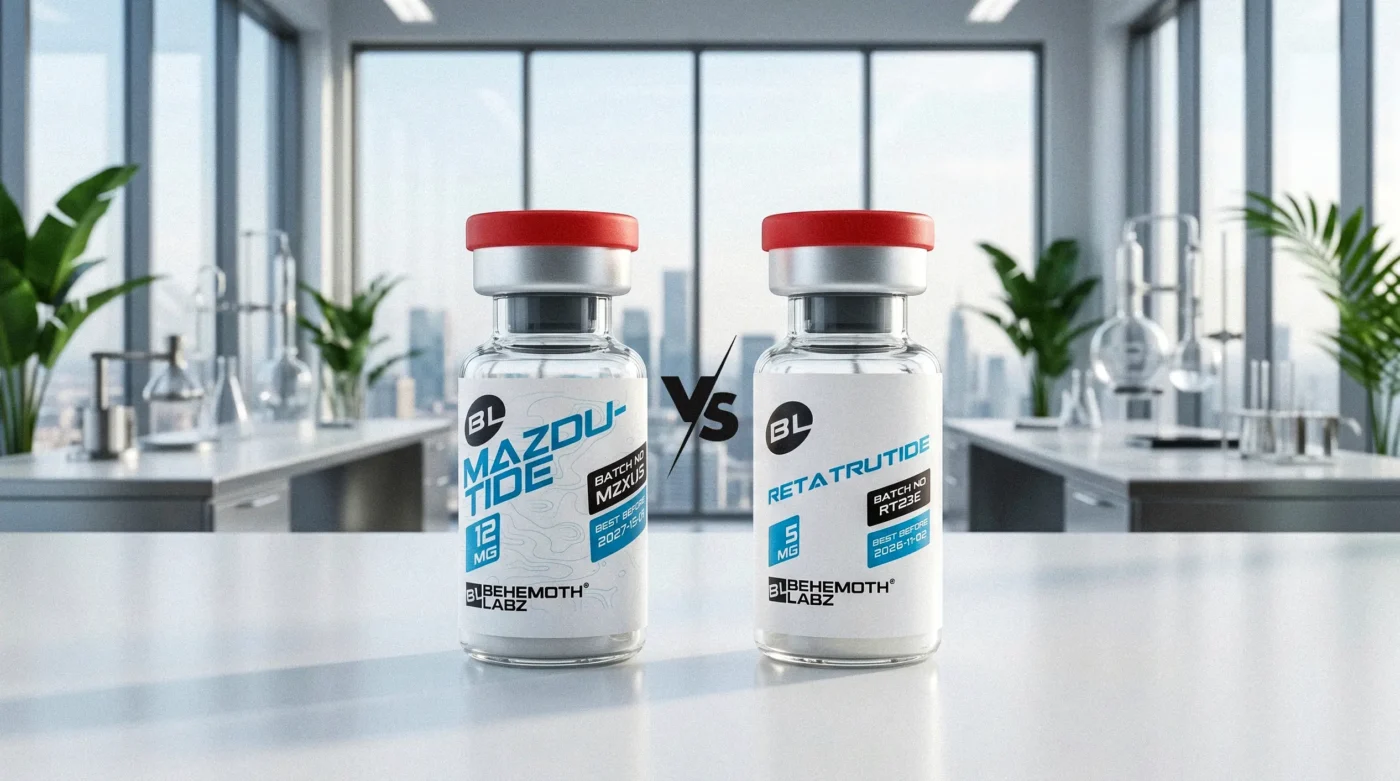
Retatrutide and Mazdutide are investigational synthetic peptide compounds under ongoing research. Both belong to the incretin-based receptor agonist class targeting GLP-1, GIP, and glucagon receptor pathways. Retatrutide is a triple receptor agonist developed by Eli Lilly. It targets GLP-1, GIP, and glucagon receptors simultaneously. Mazdutide applies a dual mechanism developed by Innovent Biologics and Sanofi. It targets GLP-1 and glucagon receptors only.
Published clinical trial data from both programs document body weight endpoint changes and metabolic marker observations in research subjects. The absence of GIP receptor engagement in Mazdutide's dual mechanism is the defining mechanistic difference between the two compounds.
This blog presents a mechanistic receptor comparison for qualified researchers in metabolic signaling and receptor biology research settings. It is not a clinical recommendation. Retatrutide has not received regulatory approval from the FDA or any regulatory authority. Mazdutide has received NMPA approval in China for two indications, but has not received FDA or EMA approval and is not approved for use in the United States.
Disclaimer: Retatrutide and Mazdutide are investigational research compounds not approved by the U.S. Food and Drug Administration (FDA) for human or veterinary use. They are not intended to diagnose, treat, cure, or prevent any disease or condition. This content is strictly for laboratory research purposes only.
What Are Retatrutide and Mazdutide? Research Compound Overview
What Is Retatrutide?
Retatrutide is a long-acting acylated peptide classified as a triple receptor agonist. It simultaneously engages GLP-1, GIP, and glucagon receptors. No other investigational compound in this class activates all three receptors simultaneously at this stage of published development. Retatrutide Nasal Spray is currently in Phase 3 clinical investigation under multiple registered trials on ClinicalTrials.gov. Phase 2 published data informs the receptor pharmacology described in this blog. It has not received regulatory approval from the FDA or any other authority.
What Is Mazdutide?
Mazdutide is a long-acting acylated peptide classified as a dual mechanism agonist. It targets GLP-1 and glucagon receptors. It does not engage the GIP receptor. Mazdutide is at the final stage of Phase 3 investigational research. Regulatory review processes are ongoing in select jurisdictions. For Mazdutide, NMPA approval has been granted for two indications in China. The next relevant milestone for US-based researchers would be a potential FDA IND application, which has not been announced at the time of writing.
What Does the Triple Agonist Concept Mean in Research?
A triple receptor agonist is a single compound that simultaneously activates three distinct receptor types. Each receptor contributes a distinct downstream signaling axis via separate cAMP-mediated cascades. GLP-1 receptor activation modulates food intake signaling and enhances insulin secretion in experimental models. GIP receptor activation modulates fat storage signaling and energy balance in adipose tissue. Glucagon receptor activation increases energy expenditure and modulates hepatic glucose output. Engaging all three simultaneously represents a comprehensive approach to receptor signaling research that no dual mechanism compound can replicate. Mazdutide's dual mechanism leaves the GIP-driven signaling axis entirely absent.
What Are the GLP-1, GIP, and Glucagon Receptor Roles in Preclinical Models?
What Does GLP-1 Receptor Activation Do in Experimental Models?
GLP-1 receptor activation is the shared mechanistic foundation of both compounds. It modulates food intake through central nervous system pathways in preclinical models. Activation slows gastric emptying and modulates gastrointestinal motility in experimental systems. It also enhances insulin secretion in a glucose-dependent manner. These observations are documented across multiple independent clinical studies and preclinical research systems.
What Does GIP Receptor Activation Do in Experimental Models?
GIP receptor activation is exclusive to Retatrutide. Mazdutide's dual mechanism does not engage this receptor. The glucose-dependent insulinotropic polypeptide receptor, known as the GIP receptor, enhances insulin secretion in a glucose-dependent manner and modulates glucagon secretion in experimental models. GIP receptor engagement also influences fat storage in adipose tissue and energy balance signaling. These GIP-specific adipose tissue and beta cell signaling observations are entirely absent from Mazdutide's dual mechanism.
What Does Glucagon Receptor Activation Do in Experimental Models?
Both compounds engage the glucagon receptor. Activation increases energy expenditure and modulates hepatic glucose output in preclinical systems through cAMP-mediated signaling. It also contributes to energy use modulation observed in trial models. In Retatrutide, glucagon receptor activation occurs alongside GLP-1 and GIP receptor engagement simultaneously. In Mazdutide's dual mechanism, it occurs alongside GLP-1 only. This difference in concurrent signaling environment influences downstream metabolic markers across experimental models.
How Do Retatrutide and Mazdutide Compare Mechanistically?
What Receptor Targets Does Retatrutide Activate?
Retatrutide demonstrates high picomolar binding affinity at the GLP-1 receptor. GIP receptor binding affinity is documented at a comparable range. Glucagon receptor binding affinity is present but reported at lower relative potency than GLP-1 and GIP receptor engagement in published structural data. All three downstream signaling axes operate concurrently in experimental models via cAMP-mediated signaling, contributing to fat oxidation and energy use modulation observed in early studies.
What Receptor Targets Does Mazdutide Activate?
Mazdutide's dual mechanism demonstrates high binding affinity at the GLP-1 receptor. Glucagon receptor binding is documented at lower relative potency than GLP-1 engagement. GLP-1 receptor activation is the dominant signaling driver in Mazdutide experimental models. The absence of GIP receptor engagement in Mazdutide's dual mechanism means one complete metabolic signaling axis, including fat storage modulation and GIP-driven fat oxidation signaling, is not accessible.
How Does GIP Receptor Presence in Retatrutide Differ From Mazdutide?
GIP receptor engagement is the single most mechanistically distinctive feature separating the two compounds. GIP receptor activation engages cAMP-dependent signaling in pancreatic beta cells and adipose tissue in preclinical systems. Neither fat storage nor GIP-specific fat oxidation signaling pathways are present in Mazdutide's dual mechanism. Retatrutide and Mazdutide therefore represent fundamentally different mechanistic architectures. Any experimental outcome attributable to GIP receptor signaling in Retatrutide data has no Mazdutide equivalent.
How Does Glucagon Receptor Activation Differ Between the Two Compounds?
Both compounds position glucagon receptor engagement as a secondary signaling component relative to their dominant GLP-1 receptor axis. In Retatrutide, concurrent GIP engagement may independently influence hepatic and adipose tissue energy use signaling. This makes direct attribution of energy expenditure observations to glucagon receptor engagement specifically more difficult in Retatrutide experimental systems than in Mazdutide's dual mechanism, where GIP is absent.
Receptor Target Comparison Table
| Property | Retatrutide | Mazdutide |
| Agonist Classification | Triple receptor agonist | Dual mechanism agonist |
| GLP-1 Receptor | Present | Present |
| GIP Receptor | Present | Absent |
| Glucagon Receptor | Present | Present |
| Glucagon Activation Level | Lower potency vs GLP-1 and GIP | Lower potency vs GLP-1 |
| Concurrent Signaling Axes | Three simultaneously | Two simultaneously |
| GIP-Specific Signaling | Fat storage, fat oxidation, and insulin modulation | Not present |
| Developer | Eli Lilly | Innovent Biologics / Sanofi |
| Current Trial Phase | Phase 3 (ongoing) | Phase 3 (NMPA approved) |
| Regulatory Status | Investigational, not approved | Investigational, not approved |
What Does Published Phase Trial Data Show for Retatrutide and Mazdutide?
Research Data Compliance Note: All clinical trial figures cited in this section document published human investigational research. They are provided for a mechanistic and receptor pharmacology comparison context only. These figures do not apply to the research-grade formulations supplied by BehemothLabz and do not constitute evidence of clinical efficacy or safety for these compounds as research materials.
The following summarizes published phase clinical trial data from peer-reviewed literature. Both compounds remain investigational. No findings constitute evidence of approved clinical efficacy or safety for human use.
What Has Published Retatrutide Trial Data Reported?
Early studies from Phase 1 established dose-response relationships for Retatrutide across multiple dose cohorts. Published retatrutide data from a Phase 2 clinical trial (Jastreboff et al. 2023, NEJM) reported mean body weight reduction of approximately 17.5% from baseline at the highest dose cohort over 24 weeks in research subjects. [Cited for receptor pharmacology context only. Documents human clinical research and does not apply to the research-grade formulation supplied by BehemothLabz.]
Key metabolic markers documented in this clinical trial data included blood sugar parameter changes, fasting glucose observations, lipid panel values, and heart rate monitoring. All figures represent investigational clinical trial data and do not constitute approved clinical performance data.
What Has Been Published about Mazdutide Data?
Clinical studies from Phase 2 established dose-response relationships for Mazdutide across multiple dose cohorts. Phase 3 GLORY-1 clinical trial data (Ji et al. 2025, NEJM) reported approximately 13.0% placebo-subtracted body weight reduction at week 32 in the 6 mg highest dose cohort, extending to approximately 14.3% at week 48. [Cited for receptor pharmacology context only. Documents human clinical research and does not apply to the research-grade formulation supplied by BehemothLabz.]
Metabolic markers documented included blood sugar parameter changes, HbA1c observations, lipid panel values, and cardiovascular outcomes monitoring. Results vary based on dose cohort and research subject criteria across published clinical studies.
How Do Primary Endpoint Observations Compare?
No head-to-head clinical trial comparing both compounds has been published. Different trial phases, cohort criteria, dose levels, and observation conditions mean no direct mechanistic comparison can be drawn from existing clinical trial data. Weight reduction percentages vary based on dose and trial design and must not be interpreted as equivalent data points.
| Metric | Retatrutide | Mazdutide |
| Body weight reduction reported | ~17.5% from baseline (24 weeks) | ~13.0% placebo-subtracted (32 weeks, 6mg) |
| Trial phase | Phase 3 (ongoing) | Phase 3 |
| Observation window | 24 weeks | 32 weeks (primary endpoint) |
| Highest dose cohort | 12 mg | 6 mg |
| Published source | Jastreboff et al. 2023, NEJM | Ji et al. 2025, NEJM (GLORY-1) |
| Head-to-head trial published | No | No |
What Safety-Related Observations Have Been Reported in Trial Data?
The following summarizes safety-related observations from published phase clinical trial data only. Neither compound is approved for human or veterinary use. No safety conclusions applicable outside a controlled research context can be drawn from this data.
What Gastrointestinal Observations Were Reported?
Gastrointestinal adverse events were the most consistently reported monitoring findings across both compound clinical trial programs. For Retatrutide, nausea-related adverse events were reported in approximately 40 to 60% of research subjects. These adverse events were most frequent in the first few weeks of dose escalation intervals. Frequencies were higher in higher dose cohorts in a dose-dependent pattern consistent with GLP-1 receptor-driven gastric emptying modulation. Most adverse events were graded as mild to moderate. Mazdutide clinical studies reported similar dose-dependent gastrointestinal adverse event profiles. Direct frequency comparison is not valid given different trial designs.
What Cardiac and Metabolic Parameter Changes Were Documented?
Heart rate parameter changes from baseline were documented across dose cohorts in both Retatrutide and Mazdutide published clinical trial data. Cardiovascular outcomes monitoring was a pre-specified endpoint in both trial protocols, given glucagon receptor engagement in both compounds. Cardiovascular risk factors, including blood pressure changes, were documented across scheduled assessment intervals. Both trial protocols included electrocardiographic monitoring. No major cardiac adverse events were documented as compound-related in published clinical trial reports for either compound.
What Other Observations Were Documented?
Sleep-related observations were documented in published Retatrutide clinical trial data. Metabolic markers, including renal and hepatic parameters, were tracked as pre-specified monitoring endpoints in both trial protocols. No compound-related renal or hepatic signals were documented as primary findings in published clinical studies for either compound. Compound withdrawal rates were higher in higher dose cohorts for both compounds. The majority of adverse events leading to withdrawal were gastrointestinal in nature.
How Are Retatrutide and Mazdutide Administered in Published Research Protocols?
What Delivery Routes Are Documented?
Both compounds have been administered via the subcutaneous delivery route in all published clinical trial protocols. This is consistent with the acylated peptide molecular structure of both compounds. Both were administered on a once-weekly interval schedule across all published dose cohorts. Early research from Phase 1 clinical studies established these administration parameters. No alternative delivery routes or interval schedules have been documented in ongoing research for either compound.
What escalation schedules have been documented?
Both clinical trial programs applied structured dose escalation schedules starting at lower dose levels before sequential increases at defined intervals. Published Retatrutide Phase 2 clinical trial data evaluated dose levels of 1 mg, 2 mg, 4 mg, 8 mg, and 12 mg alongside placebo. Published Mazdutide Phase 3 GLORY-1 clinical trial data evaluated dose levels of 3 mg, 4.5 mg, and 6 mg alongside placebo. Results for metabolic markers vary based on dose level and escalation schedule across both clinical studies. No standardized dosing protocol exists across both compounds.
What Measurement Parameters Are Specified in Trial Protocols?
Both clinical trial protocols specified baseline metabolic markers as part of the inclusion criteria, including body weight range, blood sugar thresholds, and HbA1c boundaries. On-study measurements included body weight at scheduled intervals, lipid panel values, blood sugar readings, heart rate and blood pressure documentation, liver enzyme measurements, and gastrointestinal adverse event documentation. All protocol decisions must be based on specific published clinical trial data for each compound independently.
What Does the Mechanistic Receptor Comparison Reveal? Key Differences
The mechanistic comparison reveals three defining structural differences. First, receptor target breadth: three receptors versus two. Second, the presence or absence of GIP receptor engagement, which drives distinct adipose tissue and beta cell signaling axes. Third, the differing concurrent signaling environment in which glucagon receptor activation operates in each compound. Mazdutide's dual mechanism lacks the GIP-driven fat storage, fat oxidation, and energy balance signaling axes present in Retatrutide.
Table 1: Mechanistic Receptor Profile Summary
| Property | Retatrutide | Mazdutide |
| Agonist Classification | Triple receptor agonist | Dual mechanism agonist |
| GLP-1 Receptor | Present | Present |
| GIP Receptor | Present | Absent |
| Glucagon Receptor | Present | Present |
| GIP-Specific Signaling | Fat storage, fat oxidation, energy balance | Not present |
| Regulatory Status | Investigational, not approved | Investigational, not approved |
Table 2: Published Clinical Trial Data Summary
| Observation Category | Retatrutide | Mazdutide |
| Body weight reduction reported | ~17.5% from baseline (24 weeks) | ~13.0% placebo-subtracted (32 weeks, 6mg) |
| Trial phase | Phase 3 (ongoing) | Phase 3 |
| Adverse event frequency | High, dose-dependent, mostly mild to moderate | High, dose-dependent, mostly mild to moderate |
| Cardiovascular outcomes monitored | Yes, pre-specified | Yes, pre-specified |
| Withdrawal rate | Higher in higher dose cohorts | Documented across dose cohorts |
| Head-to-head trial published | No | No |
GIP receptor engagement in Retatrutide activates adipose tissue and beta cell signaling axes, entirely absent from Mazdutide's dual mechanism. Any experimental design comparing outcomes without controlling for GIP receptor-specific contributions cannot determine what proportion of observed differences is attributable to GIP engagement. The absence of a published head-to-head clinical trial means all mechanistic comparisons from existing clinical trial data are inferential.
What Is the Regulatory Status of Retatrutide and Mazdutide?
What Is the Investigational Status of Retatrutide?
Retatrutide holds investigational new drug status under the FDA regulatory framework. It has not received regulatory approval from the FDA, European Medicines Agency, or any other regulatory authority and is not intended for clinical use outside approved investigational trial protocols. Retatrutide is currently in Phase 3 clinical investigation under multiple registered trials on ClinicalTrials.gov. Phase 2 published data informs the receptor pharmacology described in this blog. The Phase 2 program was registered under identifier NCT05394519. Ongoing research access is available exclusively through registered investigational clinical trial program participation.
What Is the Investigational Status of Mazdutide?
Mazdutide has not been submitted to the FDA and holds no investigational new drug status under the FDA regulatory framework. It is not approved for use in the United States. Mazdutide received NMPA marketing approval for two indications: chronic weight management in adults with overweight or obesity (June 2025) and glycemic control in adults with type 2 diabetes (September 2025). It has not received FDA or European Medicines Agency approval. No US IND or NDA application has been filed at the time of writing. Research access in the United States is not available through any approved pathway. US-based researchers should monitor ClinicalTrials.gov for any future IND-linked trial programs.
What Are the Projected Development Timelines?
No confirmed regulatory approval timeline can be stated for either compound. For Retatrutide, Phase 3 clinical trial data collection is estimated to require two to four additional years from Phase 3 initiation based on standard phase progression patterns in early research literature. For Mazdutide, regulatory submission preparation for NMPA review is the estimated next milestone. NMPA review timelines are estimated at one to two years from submission. Global filings represent separate subsequent milestones. Both remain investigational with no confirmed regulatory approval pathway at the time of writing.
What Are the Risks and Limitations of Retatrutide and Mazdutide Research?
This section is mandatory reading before working with either compound in any laboratory setting.
Handling Precautions
Both compounds should be handled by trained laboratory personnel only in a controlled research environment. Use appropriate PPE at all times, including a laboratory coat, nitrile gloves, and eye protection. Avoid direct skin contact or inhalation of lyophilized powder or reconstituted solution. Conduct all reconstitution under aseptic conditions. Dispose of all materials per institutional biosafety and waste disposal protocols. Neither compound should be self-administered or used outside controlled clinical research settings under a formally approved investigational research protocol.
Exposure Risks
Both compounds are biologically active investigational peptide compounds. No human safety data exists outside controlled investigational clinical trial contexts. Unintended exposure may produce biological effects not characterized outside those conditions. The multi-receptor engagement profile means unintended exposure could simultaneously modulate GLP-1, glucagon, and, in the case of Retatrutide, GIP receptor signaling via concurrent cAMP-mediated cascades. Researchers with reproductive safety concerns should consult their institutional biosafety officer before beginning experimental work.
Storage
- Store lyophilized powder at -20 degrees Celsius in a dry, dark environment
- Reconstitute with sterile phosphate-buffered saline or carrier solution per the relevant published research protocol
- Store the reconstituted solution at 4 degrees Celsius and use within 48 to 72 hours
- Avoid repeated freeze-thaw cycles, as each cycle degrades peptide integrity
- Aliquot reconstituted solution into single-use volumes before freezing
- Confirm compound integrity via Certificate of Analysis before experimental use
Toxicity and Data Limitations
No chronic toxicity data exists for either compound outside published 24-week investigational clinical trial contexts. Long-term toxicity profiles, systemic toxicity thresholds, and off-target receptor activity have not been characterized. Metabolic markers tracked in published clinical studies reflect short-duration trial observations only. Cardiovascular risk factors associated with glucagon receptor engagement require dedicated monitoring in any extended research protocol. All use must remain within approved investigational settings under institutional oversight.
Cardiac Parameter Signal Uncertainty from Glucagon Receptor Activation
Both compounds engage the glucagon receptor. Heart rate parameter changes and cardiovascular outcomes monitoring were pre-specified endpoints in both clinical trial protocols, given this shared mechanism. Cardiovascular risk factors, including heart rate elevation from baseline, were documented across dose cohorts in published clinical trial data. These adverse events were most notable in the first few weeks of higher dose escalation. Researchers conducting long-term experimental protocols must incorporate cardiac parameter monitoring into experimental design. Long-term cardiovascular outcomes observations beyond the published trial windows (24 weeks for Retatrutide Phase 2; 32–48 weeks for Mazdutide GLORY-1) have not been characterized for either compound.
What to Look for in a Supplier When Buying Research-Grade Retatrutide or Mazdutide?
Research-grade compound quality directly determines the reliability of experimental results. Sub-threshold purity introduces variables that confound downstream signaling observations. Every batch must be verified for purity and identity before experimental use.
- Third-party testing: Purity and identity must be confirmed by an independent laboratory.
- Certificate of Analysis: Must include HPLC purity trace and mass spectrometry identity confirmation with lot-specific traceability.
- Purity threshold: Minimum 98% purity by HPLC for research-grade synthetic peptide compounds.
- Endotoxin testing: Mandatory for compounds used in cell-based or in vivo experimental systems.
- Cold-chain compliance: Suppliers must confirm that storage and shipping conditions maintain compound integrity.
You can try trusted sites like BehemothLabz for Retatrutide and BehemothLabz for Mazdutide, where all compounds are sold strictly for preclinical and in vitro research use.
Note: All BehemothLabz products are strictly for LABORATORY AND RESEARCH PURPOSES ONLY. They are not to be used for any human or veterinary purposes.
Disclosure: Sponsored by BehemothLabz. This content is for informational purposes only and does not constitute an endorsement of any product for human use.
Frequently Asked Questions
What is the mechanistic difference between Retatrutide and Mazdutide?
Retatrutide is a triple receptor agonist activating GLP-1, GIP, and glucagon receptors simultaneously via three concurrent signaling axes. Mazdutide applies a dual mechanism activating GLP-1 and glucagon receptors only. The presence of GIP receptor engagement in Retatrutide and its complete absence in Mazdutide's dual mechanism is the defining difference. Both remain investigational. Neither has received regulatory approval for any use outside controlled research settings.
What receptors does Retatrutide target compared to Mazdutide?
Retatrutide targets GLP-1, GIP, and glucagon receptors simultaneously. Mazdutide's dual mechanism targets GLP-1 and glucagon receptors simultaneously. The GLP-1 and glucagon receptor targets are shared. The glucose-dependent insulinotropic polypeptide receptor is exclusively engaged by Retatrutide. No other investigational compound in this class currently engages all three receptor targets simultaneously at the same stage of published ongoing research.
What does GIP receptor activation add to Retatrutide's mechanism that Mazdutide lacks?
GIP receptor activation adds a third concurrent signaling axis absent from Mazdutide's dual mechanism. In early research and early studies, GIP receptor engagement has been associated with fat storage modulation in adipose tissue, fat oxidation signaling, additional insulin secretion enhancement in pancreatic beta cell systems, and energy balance observations. None of these GIP-specific contributions via adipose tissue and beta cell signaling are present in Mazdutide's dual mechanism. Whether GIP receptor engagement independently contributes to body weight reduction differences between the two compounds has not been confirmed in published controlled experimental clinical studies.
What do published trial reports show for body weight endpoints in Retatrutide and Mazdutide research?
Published Phase 2 Retatrutide clinical trial data reported approximately 17.5% mean body weight reduction from baseline at the highest dose cohort over 24 weeks. Published Phase 3 Mazdutide GLORY-1 clinical trial data (Ji et al. 2025, NEJM) reported approximately 13.0% placebo-subtracted body weight reduction at week 32 in the 6 mg cohort, extending to approximately 14.3% at week 48. Results vary based on trial phase, cohort criteria, and dose levels. These clinical trial data figures cannot be directly compared. No head-to-head clinical trial has been published. All figures represent investigational clinical trial data only.
Are Retatrutide and Mazdutide approved for human use?
No. Neither Retatrutide nor Mazdutide has received FDA regulatory approval for human or veterinary use in the United States. Retatrutide holds investigational new drug status under the FDA regulatory framework and is currently in Phase 3 clinical investigation. Mazdutide has received NMPA approval in China for two indications, but has not received FDA or EMA approval and is not approved for use in the United States. Both are strictly for laboratory and scientific research purposes. Access is restricted to qualified professionals in approved investigational research protocols.
What are the risks of working with Retatrutide and Mazdutide in research settings?
Both compounds must be handled by qualified laboratory professionals only in controlled research environments with full PPE. Neither compound should be ingested or self-administered under any circumstances. No chronic toxicity data exists outside published 24-week investigational clinical trial contexts. Cardiovascular risk factors and adverse events from glucagon receptor engagement are specific risk considerations documented in published clinical trial data for both compounds. Metabolic markers must be tracked throughout any experimental protocol. All use must remain within approved preclinical and in vitro research protocols under institutional biosafety oversight.
References
Reference 1 — Jastreboff 2023:
https://pubmed.ncbi.nlm.nih.gov/37385280/
Reference 2 — Ji et al. 2025 GLORY-1:
https://www.nejm.org/doi/full/10.1056/NEJMoa2411528
Reference 3 — Drucker 2006:
https://doi.org/10.1016/j.cmet.2006.01.004
Reference 4 — Nauck & Meier 2018:
https://doi.org/10.1111/dom.13078
Reference 5 — Finan 2013:
https://doi.org/10.1126/scitranslmed.3007218
Reference 6 — Coskun 2018:
https://doi.org/10.1016/j.molmet.2018.09.009
Reference 7 — Willard 2020:
https://doi.org/10.1172/jci.insight.140532
Reference 8 — Knerr 2022:
https://doi.org/10.1111/bph.15648
Reference 9 — Day 2009:
https://doi.org/10.1038/nchembio.209
Reference 10 — Campbell & Drucker 2013:
https://doi.org/10.1016/j.cmet.2013.08.012
Reference 11 — Samms 2020:
https://doi.org/10.1016/j.tem.2020.02.006
Reference 12 — Tseng 1996:
https://doi.org/10.1016/0196-9781(96)00133-4