


Peptides
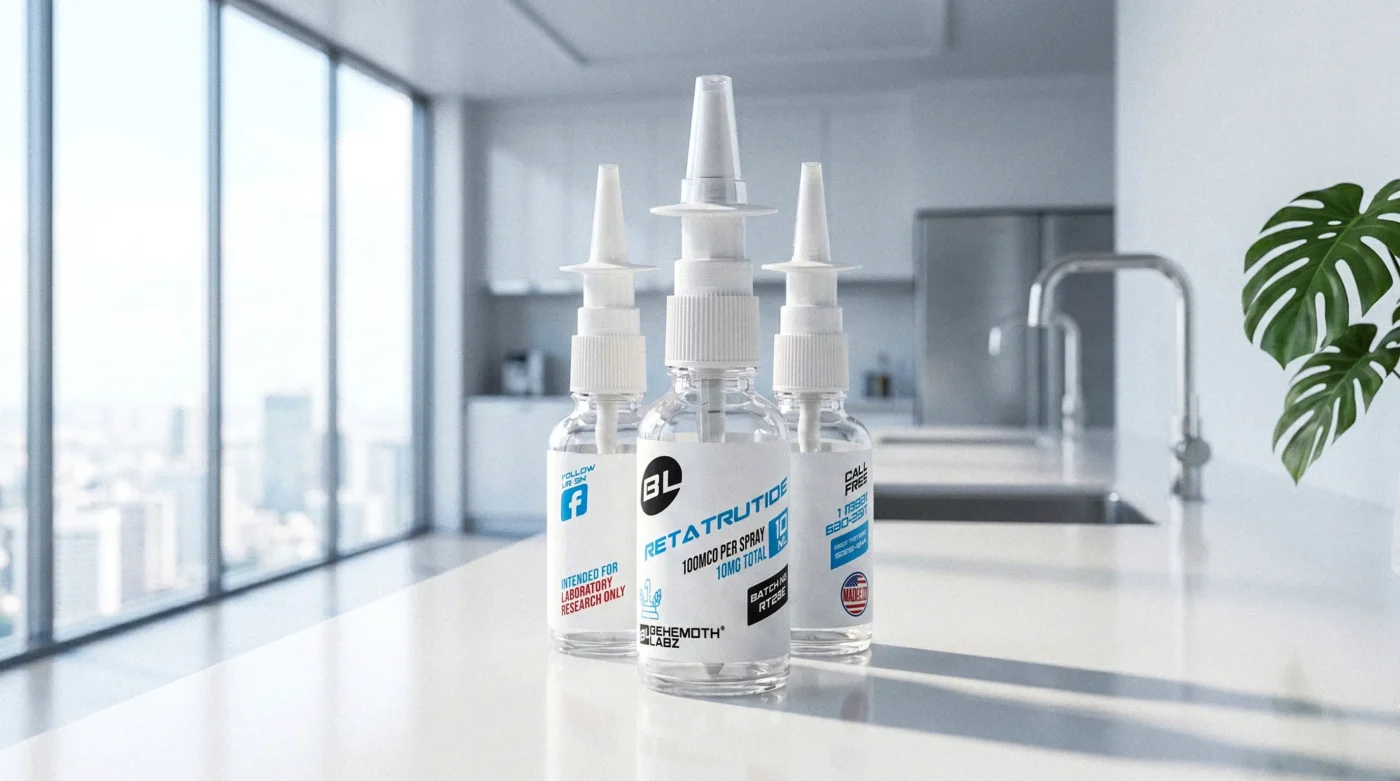
Retatrutide Nasal Spray (Intranasal Formulation)
Jun
Now Available for Preclinical Research Use
Retatrutide Nasal Spray (LY3437943) is a synthetic peptide investigated in preclinical and in vitro models as a triple agonist at GLP-1, GIP, and glucagon receptors. An intranasal formulation is being explored as an alternative delivery format in laboratory research settings. All findings remain experimental. The FDA does not approve this compound for human use, and long-term data are still evolving.
Disclaimer: Retatrutide Nasal Spray is a research compound not approved by the U.S. Food and Drug Administration (FDA) for human or veterinary use. It is not intended to diagnose, treat, cure, or prevent any disease. This product is strictly for laboratory research purposes only.
There is a reason researchers keep coming back to retatrutide. It does not interact with one receptor pathway or two. It may engage three simultaneously. GLP-1, GIP, and glucagon receptors all at once. That is what makes it mechanistically distinct from everything that came before it in preclinical incretin research. Compounds targeting GLP-1 alone hit one receptor. Dual agonists hit two. Retatrutide, also known as LY3437943, may interact with all three.
But the compound itself is only part of the research question. The delivery format is the other. This blog explores what the science currently shows:
- The receptor interactions under investigation
- The intranasal delivery pathway research, and
- The limitations every researcher needs to understand
What Is Retatrutide (LY3437943)?
Retatrutide is a synthetic 39-amino-acid peptide. It is classified as a triple hormone receptor agonist. It is a single molecule with potential simultaneous agonist activity at three G protein-coupled receptors:
- GLP-1R - glucagon-like peptide-1 receptor
- GIPR - glucose-dependent insulinotropic polypeptide receptor
- GCGR - glucagon receptor
This tri-receptor profile is what distinguishes retatrutide as a research tool from earlier compounds in the incretin class. In in vitro assays, retatrutide has been observed to act as a balanced agonist at GLP-1R and GCGR, while demonstrating enhanced potency at the GIPR (approximately 8.9 times more potent than endogenous GIP at that receptor).
Its pharmacokinetics are considered dose-proportional in preclinical models, with a half-life of approximately six days observed in experimental settings.
The nasal spray formulation is an investigational intranasal preparation of retatrutide intended for in vitro and preclinical receptor pharmacology research only. It is not a clinical product and is not approved for any human application.
Why Is Intranasal Delivery Being Investigated in Peptide Research?
Intranasal delivery is being investigated because it may offer an alternative pharmacokinetic route compared to subcutaneous injection. Research suggests intranasally administered compounds may reach the central nervous system via olfactory and trigeminal nerve pathways, potentially bypassing the blood-brain barrier in some experimental models.
Most peptides face a fundamental challenge with administration. They are rapidly degraded in the gastrointestinal tract, which may make oral delivery largely ineffective. Subcutaneous injection has been the primary research delivery route so far. But this introduces variables around absorption rate and systemic exposure that can complicate preclinical model design.
Intranasal delivery may offer a third option. This direct nose-to-brain route may allow for a different pharmacokinetic profile compared to systemic routes.
What Research Variables Does Nasal Delivery Introduce?
Researchers working with intranasal peptide formulations should consider the following variables:
- Mucosal enzymatic activity: The nasal epithelium contains proteolytic enzymes that may degrade peptides before absorption
- Molecular weight constraints: Smaller peptides may absorb more efficiently; larger molecules may face greater transport limitations across the nasal epithelium
- Absorption variability: Mucosal conditions, nasal pH, and formulation characteristics may all influence how much compound is absorbed per administration
- No published intranasal-specific data for retatrutide: As of 2026, no peer-reviewed data have characterized nose-to-brain transport dynamics specifically for retatrutide or LY3437943
How Is Retatrutide Thought to Interact with Its Target Receptors?
In preclinical and in vitro models, the mechanism of retatrutide involves potential simultaneous engagement of three G protein-coupled receptors. Each pathway is described below as it has been observed in experimental settings, not as established human pharmacology.
GLP-1R Pathway: What Preclinical Models Suggest?
In in vitro and animal model research, GLP-1 receptor engagement by compounds in this class has been associated with:
- Modulation of feeding behavior signaling pathways in rodent models
- Insulin secretion in a glucose-dependent manner in isolated pancreatic cell preparations
- Suppression of glucagon secretion in experimental settings
- Delayed gastric emptying has been observed in animal model studies
Retatrutide's activity at GLP-1R is thought to be lower potency than endogenous GLP-1 (approximately 0.4 times)
GIPR Pathway: What Preclinical Models Suggest?
The GIPR pathway has attracted increasing interest in metabolic receptor research. In in vitro assays, retatrutide may demonstrate approximately 8.9 times greater potency at the GIP receptor compared to endogenous GIP. In experimental settings, GIP receptor activation by compounds in this class has been studied in the context of:
- Insulin secretion modulation in pancreatic beta-cell model systems
- Adipose tissue signaling pathway investigation in preclinical metabolic models
- Energy expenditure pathway research in rodent experimental subjects
GCGR Pathway: What Preclinical Models Suggest?
Glucagon receptor agonism is the pathway that most distinguishes retatrutide from earlier incretin research compounds. In preclinical models, GCGR activation by compounds in this class has been associated with:
- Hepatic fat oxidation pathway investigation in animal models
- Thermogenic signaling pathway research in preclinical subjects
- Lipolytic signaling in isolated adipose tissue model systems
Retatrutide's GCGR activity is thought to be lower than endogenous glucagon (approximately 0.3 times)
What Research Applications Is Retatrutide Being Investigated For?
The following are areas of preclinical and in vitro investigation only. None of these represents approved indications or established human pharmacology.
1. Triple-receptor binding kinetics research:
Retatrutide may be used in cell-free and cell-culture assay systems to investigate simultaneous engagement of GLP-1R, GIPR, and GCGR. Its distinct potency profile across the three receptors may make it a useful probe for comparative receptor pharmacology studies.
2. Metabolic signaling pathway research:
In rodent experimental models, retatrutide has been investigated as a tool compound for studying coordinated regulation of energy homeostasis signaling, lipid metabolism pathways, and glucose regulation mechanisms through simultaneous incretin receptor activation.
3. Hepatic lipid pathway research:
In preclinical animal models, compounds engaging the GCGR pathway have been associated with hepatic fat oxidation signaling. Retatrutide may serve as a research tool for investigating these pathways in laboratory settings.
4. Intranasal peptide delivery research:
The nasal spray formulation may be used to investigate pharmacokinetic differences between intranasal and subcutaneous delivery routes for large synthetic peptides in preclinical model systems.
5. Structure-activity relationship studies:
The fatty acid conjugation and non-coded residue modifications in retatrutide's structure may be relevant to SAR research investigating how structural modifications affect receptor selectivity and half-life in synthetic peptide compounds.
Retatrutide vs Semaglutide vs Tirzepatide:
Researchers working across the incretin compound class frequently need to distinguish between these compounds when designing experimental models.
| Parameter | Retatrutide | Tirzepatide | Semaglutide |
| Receptor targets | GLP-1R, GIPR, GCGR | GLP-1R, GIPR | GLP-1R only |
| Mechanism class | Triple agonist | Dual agonist | Mono agonist |
| GCGR activity | Yes (~0.3x endogenous) | No | No |
| GIPR potency vs endogenous | ~8.9x | Balanced | N/A |
| Half-life (preclinical) | ~6 days | ~5 days | ~7 days |
| Research status | Investigational - not approved | Investigational reference | Investigational reference |
Note: References to FDA-approved status for tirzepatide and semaglutide are provided for comparative receptor pharmacology context only. Both compounds have received FDA approval for specific clinical indications in their pharmaceutical forms and under regulated medical supervision. Retatrutide is not approved by the FDA for any indication in any formulation. No information in this table constitutes a recommendation, endorsement, or implication of human use for any compound listed.
What are the Risks and Limitations of Retatrutide Nasal Spray?
This section is mandatory reading before working with Retatrutide Nasal Spray in any laboratory setting.
Handling Precautions: Retatrutide Nasal Spray should be handled by trained laboratory personnel only, in a controlled research environment. Use appropriate PPE at all times. Avoid direct skin contact or inhalation of any reconstituted solution.
Exposure Risks: Retatrutide is a triple hormone receptor agonist research peptide that may modulate GLP-1, GIP, and glucagon receptor signaling pathways in preclinical models. No human safety data exists for this compound in any formulation. In the event of accidental laboratory exposure, follow standard institutional biosafety procedures and consult safety documentation.
Storage: Store lyophilised Retatrutide Nasal Spray at −20°C in a dry, dark environment. Protect from light, heat, and moisture at all times.
Toxicity and Data Limitations: No chronic toxicity data exist for Retatrutide Nasal Spray. All available findings are from short-duration preclinical animal models or in vitro assay systems only. No intranasal-specific bioavailability, CNS penetration, or mucosal tolerability data have been published in peer-reviewed literature for this compound.
Conclusion
Retatrutide Nasal Spray is a mechanistically complex research compound with an equally complex delivery question attached to it. The triple-receptor profile, i.e., the potential simultaneous GLP-1R, GIPR, and GCGR agonism, may distinguish it from all prior compounds in the incretin research class as a preclinical tool. The intranasal format adds a pharmacokinetic dimension that remains entirely uncharacterized in published peer-reviewed literature.
What preclinical in vitro data suggest is that the compound's receptor architecture may be unusually broad. But research on the nasal delivery format specifically remains an open question. Data remains limited. Evidence is absent for the intranasal formulation specifically.
Frequently Asked Questions
What receptors may Retatrutide interact with in preclinical models?
In experimental settings, retatrutide is thought to potentially engage three G protein-coupled receptors simultaneously: GLP-1R, GIPR, and GCGR.
Why is nasal spray being investigated as a delivery format for retatrutide research?
Because it may offer a different pharmacokinetic profile compared to subcutaneous administration. However, no peer-reviewed data specific to retatrutide intranasal delivery has been published.
Is Retatrutide Nasal Spray the same as subcutaneous retatrutide?
No. The nasal spray formulation is a distinct research preparation with a different delivery route and potentially a different pharmacokinetic profile.
Is Retatrutide approved for human use?
No. Retatrutide is not approved by the FDA or any other regulatory authority for human use in any formulation. It is supplied strictly for laboratory research purposes only.
What to Look for in a Supplier when buying research-grade Retatrutide Nasal Spray?
Check that every batch is independently third-party tested for purity and identity, and a Certificate of Analysis is available for each lot. You can try trusted sites like BehemothLabz, where all compounds are sold strictly for preclinical and in vitro research use.
Note: All BehemothLabz products are strictly for LABORATORY AND RESEARCH PURPOSES ONLY. They are not to be used for any human or veterinary purposes.
Disclosure:
Sponsored by BehemothLabz. This content is for informational purposes only and does not constitute an endorsement of any product for human use.
References
[1] Jastreboff AM, Kaplan LM, Frías JP, et al. Triple–Hormone-Receptor Agonist Retatrutide for Obesity - A Phase 2 Trial. New England Journal of Medicine. 2023;389(6):514–526. https://pubmed.ncbi.nlm.nih.gov/37385280/
[2] Li W, Zhou Q, Cong Z, et al. Structural insights into the triple agonism at GLP-1R, GIPR and GCGR manifested by retatrutide. Cell Discovery. 2024;10:77. https://pubmed.ncbi.nlm.nih.gov/39019866/
